In this article (16 sections)
Are you looking for a way to save more money for your retirement? An SRS account can be a great option. It not only helps you save money but also gives you tax benefits. However, before opening an SRS account, there are a few things that you should know. In this blog, we will cover the nitty-gritty of Supplementary Retirement Scheme and why it may or may not be the right choice for you. From understanding how the scheme works to evaluating if the money saved is worth the hassle, we will discuss all aspects of SRS so that you can make an informed decision about your retirement savings plan. So let's dive in and explore everything you need to know about Supplementary Retirement Scheme.
How Does an SRS Account Work?

Unlike the funds in our CPF (Central Provident Fund) accounts, which offer a relatively attractive risk-free interest rate ranging from 2.5% to 5% annually, contributions made to your SRS (Supplementary Retirement Scheme) account yield a considerably lower nominal interest rate of only 0.05% per annum. This rate is comparable to the basic interest rates typically found in most standard bank savings accounts in Singapore.
However, despite the modest tax returns on your SRS contributions, the primary advantage that the SRS offers is its appealing tax benefits. When you make voluntary contributions to your SRS account, you become eligible for a dollar-for-dollar srs tax relief. This means that the amount you contribute to your SRS account is deducted from your taxable income, reducing the income on which you need to pay taxes. This tax relief can significantly lower your overall tax liability.
It's worth noting that the current annual SRS contribution cap is set at $15,300 for Singapore citizens and Singapore permanent residents, while foreign individuals enjoy a higher cap of $35,700. This cap represents the maximum amount you can contribute to your SRS account in a given year while still benefiting from the associated tax relief. By taking advantage of this tax-saving opportunity and strategically managing your SRS contributions, you can effectively reduce your tax burden and save more for your retirement in the long term.
Checked our Frequently Asked Questions for more Information.
5 Things to Understand Before Opening an SRS Account in Singapore
Before you decide to open an SRS account, here are the 5 important things you should first understand.

1. Is the Money Saved Worth the Hassle?
Evaluate the potential financial benefits of saving with an SRS account. Weigh the advantages of tax relief and investment growth against the effort involved. Consider the long-term impact of SRS contributions on your retirement nest egg. Assess whether the potential tax savings outweigh the limitations and restrictions of SRS accounts. Make an informed decision on whether opening an SRS account is worth it for you.
Each dollar you contribute to your Supplementary Retirement Scheme (SRS) account has a direct and beneficial impact on your tax liabilities in the subsequent Year of Assessment (YA). The mechanics are straightforward: for every dollar you contribute to your SRS, your income chargeable to tax is reduced by an equivalent dollar amount in the upcoming tax year.
For the tax year 2018, Singaporean citizens and Permanent Residents (PRs) have a maximum SRS contribution limit of $15,300, while foreigners enjoy a more generous cap of $35,700. This means you can contribute up to these amounts to your SRS account, effectively reducing your taxable income for the year.
Let's illustrate this with an example. Suppose you fall within the 15% marginal tax bracket, which typically encompasses a chargeable income ranging from $120,000 to $160,000. If you contribute the maximum allowed amount of $15,300 to your SRS this year, you can anticipate substantial tax savings in the following year.
With the 15% marginal tax rate and a $15,300 SRS contribution, you can expect to save $2,295 on your tax bill in the next Year of Assessment. This represents a significant reduction in your overall tax liability and, in essence, amounts to a quite substantial sum that you get to keep in your pocket. These tax savings can then be wisely channeled into your retirement fund, allowing you to enhance your financial security and prepare for a comfortable retirement.
For you to calculate your tax savings, you can use our tax savings calculator here.
It's important to take note that for the Year of Assessment 2019 (which pertains to income earned in the year 2018), there is a cap on the total amount of personal income tax relief you can claim. This cap is set at $80,000. This means that while you can enjoy different tax reliefs to reduce your overall tax liability, these deductions are subject to the $80,000 limit.
Also Read: 12 Mistakes in Retirement Planning You Should Avoid
2. How You Intend to Invest Your SRS Contribution?

When considering how to invest your SRS contribution, it's important to explore different investment options available for SRS funds.
It is important to know that any unused contributions within your Supplementary Retirement Scheme (SRS) account will only yield a nominal interest rate of 0.05% per annum. This relatively low interest rate means that if you want to secure a better return on your SRS savings, it's advisable to consider investing those contributions rather than leaving them to languish in your SRS account, where they may be susceptible to the erosive effects of inflation.
When it comes to investing your SRS funds, you have a wide array of options available, allowing you to tailor your investment choices according to your personal preferences and risk tolerance. These investment options include stocks, bonds, fixed deposits, unit trusts, and annuity plans, as well as government-approved SRS investment products such as Real Estate Investment Trusts (REITs), Singapore Savings Bonds (SSBs), and Regular Shares Savings (RSS) plans. Each of these instruments has its unique characteristics, risk profiles, and potential returns.
By directing your SRS funds into these investment options, you not only enjoy immediate tax savings – a key benefit of the SRS – but you also create an opportunity to potentially earn a higher investment return on your contributions over time. This growth in your SRS investments can significantly bolster your retirement savings, helping you achieve your financial goals in the long run.
However, it's essential to approach SRS investments with a prudent mindset. As with all forms of investments, there is an inherent risk of incurring losses. Therefore, it's crucial to carefully assess your risk tolerance and investment objectives before diving into SRS investments. Diversifying your investments, conducting thorough research, and seeking professional financial advice if needed can help you make informed decisions and mitigate potential risks.
3. How Much Tax Savings Will I Be Enjoying?
Understand the potential tax savings from contributing to an SRS account. Explore the income of srs relief and its impact on your taxable income and tax bracket. Maximize your savings through strategic contributions and determine your actual tax savings based on your financial circumstances.
The primary motivation behind opening an SRS (Supplementary Retirement Scheme) account is to leverage the significant tax savings it offers while simultaneously building a nest egg for retirement. To determine the extent of these tax benefits, it's crucial to first understand how much income tax you are liable to pay each year, and subsequently, calculate the potential tax savings that would result from contributing to your SRS account.
Here's a rough estimation of the income tax you can anticipate paying based on your annual income, both before and after your SRS contribution:
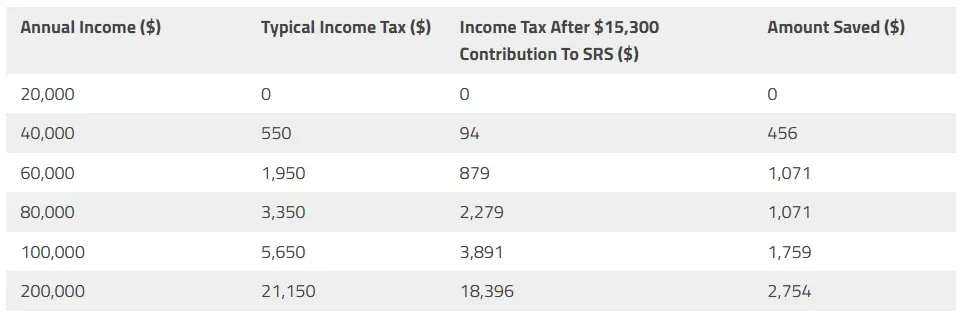
As illustrated in the table, it becomes evident that individuals with higher taxable incomes have a more substantial incentive to contribute to their SRS accounts. This is because they can effectively reduce their income tax liability by a more significant amount through their SRS contributions.
For instance, consider an individual with an annual income of $200,000. By contributing the maximum allowable amount of $15,300 to their SRS account, they can potentially save up to $2,754 in taxes. On the other hand, an individual earning $40,000 annually would only save $456 by making the same contribution. This discrepancy arises from Singapore's progressive income tax system, where individuals with higher incomes are subject to higher tax rates. Consequently, a reduction in their assessable income through CPF SA top ups translates to more substantial tax savings.
It's important to note that these calculations assume individuals do not receive any additional tax relief or personal income tax rebates. For a more precise assessment of how a contribution to your SRS account could impact your income tax for the Year of Assessment (YA) 2017 (as an example), it's advisable to perform a personalized calculation. Understanding the potential tax savings associated with your SRS contributions allows you to make informed decisions regarding your retirement planning and take full advantage of the tax benefits the SRS provides.
4. Do You Have Foreseeable Cash Need in the Near Future?

The benefit of tax savings is undoubtedly a compelling incentive when considering contributing to a Supplementary Retirement Scheme (SRS). However, it is necessary to carefully weigh this benefit against your current and future financial needs, particularly the need for liquidity.
One significant aspect to bear in mind is that monies contributed to your SRS account are subject to strict withdrawal restrictions until you reach the statutory retirement age of 62. This means that premature withdrawals come with both tax implications and penalties. In fact, early withdrawals from your SRS account can be quite punitive, as they are not only taxed at a rate of 100%, but they also incur an additional 5% penalty.
Given these restrictions and potential penalties, it's important to exercise caution when deciding the amount to contribute to your SRS account. If you have immediate or foreseeable cash needs, such as for emergencies, major expenses, or other financial commitments, it may not be advisable to channel large sums of money into your SRS account. Doing so could leave you financially vulnerable and hinder your ability to address unexpected expenses.
To strike a balance between securing tax benefits and maintaining liquidity, it's advisable to prioritize building up a comfortable emergency fund. An emergency fund acts as a financial safety net, providing you with readily available cash to cover unforeseen expenses, such as medical bills, car repairs, or urgent home repairs. By establishing and maintaining a robust emergency fund, you can mitigate the risk of being forced to make premature withdrawals from your SRS account.
In essence, the amount you contribute to your SRS should primarily consist of savings earmarked for your retirement in the years to come. These funds should not be money you anticipate needing in the foreseeable future for non-retirement purposes. By adopting this prudent approach, you can maximize the long-term benefits of your SRS account while ensuring that your financial well-being remains secure in the face of life's unexpected challenges. It is important to start planning and saving for retirement at an early age, ideally in your 20s or 30s, to ensure that you have enough funds to sustain your lifestyle post-retirement at 65 years of age.
5. Penalty for Early Withdrawal

The most significant drawback associated with the Supplementary Retirement Scheme (SRS) account lies in the penalties and tax implications imposed on withdrawals made before the statutory retirement age of 62. This is a crucial consideration for individuals contemplating the use of their SRS funds for non-retirement purposes.
To put it into perspective, when you make an early withdrawal from your SRS account, a 5% penalty is charge on the withdrawn amount. So, for instance, if you decide to withdraw $10,000 from your SRS account before reaching the age of 62, you would incur a penalty of $500 (equivalent to 5% of the withdrawal amount). Not only that, the entire $10,000 would be added to your taxable income for the year in which the withdrawal occurs. This means that the withdrawn amount would be subject to the standard income tax rates, potentially resulting in a significant tax liability.
Given these financial penalties and tax obligations, it is prudent to approach SRS contributions with careful consideration. It's advisable to only contribute funds to your SRS account if you have a high level of confidence that you won't require the money for other purposes in the future. In essence, you should view SRS contributions as a long-term commitment towards your retirement savings.
It's important to emphasize that the 5% penalty for early withdrawal is a substantial financial disincentive that could potentially cancel any tax savings you initially enjoyed through SRS contributions. As such, it's important to weigh the immediate tax benefits against the potential financial penalties and taxes that may apply to early withdrawals.
However, there are exceptions to this penalty rule. In certain exceptional circumstances, such as death, severe medical conditions, bankruptcy, or for foreigners who have maintained their SRS account for at least a decade from their first contribution, the 5% penalty for early withdrawal does not apply. These exceptions recognize that unforeseen and exceptional situations may necessitate the use of SRS funds before the statutory retirement age, such as withdrawals made on medical grounds.
The decision to contribute to an SRS account should be made with a clear understanding of the penalties and tax implications associated with early withdrawals. To maximize the benefits of your SRS savings scheme, it's advisable to contribute with a long-term retirement goal in mind, unless you find yourself in exceptional circumstances that warrant an early withdrawal without incurring the 5% penalty.
Is it worth opening an SRS account?
Considering the pros and cons, tax benefits, investment opportunities, and personal financial goals are crucial in deciding whether opening an SRS account is worth it. Compare with other retirement savings options and seek professional advice to align with your retirement planning strategy. Make an informed decision based on your individual circumstances.
How Can You Grow Your SRS To Meet Your Retirement Needs?
To grow your SRS account and meet your retirement needs, You have to diversify your portfolio to avoid unnecessary risks. Here are 6 ways that will enable you to grow your funds in your SRS Account:

1. Endowment Insurance Plans
The Supplementary Retirement Scheme (SRS) offers a unique avenue for individuals to manage their financial future, and one intriguing aspect of this scheme is the opportunity to deploy SRS funds towards the acquisition of specific endowment insurance plans. These specialized plans not only enable you to nurture and expand your SRS savings but also provide a valuable layer of insurance coverage against two significant life events: death and total permanent disability (TPD) during the defined policy term. However, it's essential to be aware that other life insurance plans, such as those covering critical illness, health, and long-term care, are regrettably excluded from this range of eligible options. Considering the underlying principle of SRS, which allows for penalty-free withdrawals only upon reaching the statutory retirement age, it becomes particularly prudent to explore medium-term endowment insurance plans. These plans harmoniously align with the long-term objectives of SRS, as they facilitate the gradual growth of your savings over a predetermined period, all the while affording you the peace of mind that comes with insurance coverage.
2. Unit Trusts
The option to invest SRS funds in Unit Trusts not only aligns with the goal of saving for retirement but also presents a compelling opportunity to benefit from the knowledge and analysis provided by financial institutions. With a diverse selection of over 70 Unit Trust funds available, SRS account holders have the flexibility to tailor their investments to their individual financial goals and risk tolerance, ultimately contributing to a well-rounded retirement strategy.
3. Shares/ ETFs
The Supplementary Retirement Scheme (SRS) offers individuals a versatile array of investment choices, and one of the intriguing possibilities is to utilize SRS funds to purchase securities on the Singapore Stock Exchange, with the exception of American Depository Receipts. This option opens up an exciting avenue for SRS account holders to engage in the stock market and potentially harness the opportunities it offers. Within the realm of stock market investments, "Blue Chips" stand out as an appealing option.
Blue Chip stocks represent shares in well-established and highly reputable companies with a longstanding history of profit growth and consistent dividend payments. These companies are typically renowned for their stability, resilience in the face of economic downturns, and sustained profitability. Being listed on a stock exchange, they offer investors the opportunity to participate in the success of these industry giants.
Investing in Blue Chips through SRS can be seen as a strategic move, as these companies are often considered as cornerstones of a robust investment portfolio, known for their ability to generate steady returns over time. Another intriguing investment avenue is Exchange Traded Funds (ETFs), which are designed to track the performance of a specific index, commodity, bonds, or a basket of assets similar to an index fund.
ETFs offer investors a diversified exposure to a range of assets within a single investment vehicle. Singapore-based ETFs, in particular, can provide SRS account holders with an opportunity to spread their investments across various assets, potentially reducing risk and enhancing diversification.
These funds offer convenience and flexibility, and they can be particularly attractive for those looking to build a well-balanced and diverse SRS portfolio.
4. Singapore Government Securities
The Supplementary Retirement Scheme (SRS) encompasses a range of investment options to cater to the diverse preferences and financial goals of individuals planning for their retirement. One notable choice within the SRS framework is the ability to employ SRS funds for the acquisition of Singapore Government Securities. These securities are essentially debt instruments that are firmly supported by the full credit and backing of the Singapore Government. Investing in these government-backed instruments offers SRS account holders an avenue to add diversity and stability to their investment portfolios. Singapore Government Securities come in different forms, and among the most prominent are SGS Bonds and SGS Treasury Bills. These instruments are considered some of the most secure and reliable investments available.
5. Structured Deposits

Structured Deposits, as a financial product, combine the characteristics of a traditional deposit account with those of an investment products. They offer an innovative approach to managing and potentially growing your savings. The primary feature that distinguishes structured deposits from regular savings accounts is that the returns they offer are typically linked to the performance of an underlying financial instrument, such as a stock, bond, or market index.
Structured deposits are known for their versatility, and different tranches or variations of these deposits may come with distinct features. These features could encompass a wide range of possibilities, such as the potential for capital growth, regular interest payments, or even a combination of both. The specifics of each structured deposit can vary, providing investors with choices that align with their financial objectives and risk tolerance.
One of the key characteristics that make structured deposits appealing is the assurance that the principal amount you invest will be returned to you if you hold the investment until it reaches its maturity date. This provides a sense of security, knowing that you'll receive at least your initial investment back, regardless of the performance of the underlying financial instrument.
However, it's important to note that this assurance is contingent on the bank remaining solvent throughout the investment period. This aspect underscores the importance of selecting a reputable and financially stable institution when considering structured deposits.
Structured deposits offer an opportunity for individuals to diversify their investment portfolio and potentially benefit from market movements, all while safeguarding their principal amount. The flexibility and tailored features of different tranches allow investors to choose the structured deposit that best aligns with their financial goals and risk appetite.
It's important to carefully assess the terms and conditions of each structured deposit, understand the underlying financial instrument, and consider your own financial situation before deciding to invest in one.
6. Time Deposits
Another viable avenue for individuals seeking to maximize the benefits of their Supplementary Retirement Scheme (SRS) funds is to consider placing these funds in time deposits. This option provides a secure and reliable means of potentially earning higher returns, all while offering the added advantage of fixed tenures that can extend up to 36 months.
Time deposits are a well-established financial instrument that is widely recognized for its stability and predictable returns. When you opt to invest your SRS funds in time deposits, you are essentially setting aside a specific amount of money with a financial institution for a predetermined period.
This period, also known as the tenure, can vary depending on your preference, but it often ranges from several months to a few years. The key attraction of time deposits is that they offer a fixed interest rate over the entire tenure, which means you can accurately anticipate the return on your investment.
The secure nature of time deposits is a primary reason why they are a popular choice for conservative investors. Your principal amount is protected, and you can rely on the predetermined interest rate to generate a steady income stream. This predictability can be especially valuable for those planning for their retirement, as it allows for precise financial planning and budgeting.
The Supplementary Retirement Scheme, with its focus on building a nest egg for retirement, is well-suited to take advantage of time deposits. These instruments provide an opportunity to grow your SRS savings with a relatively low level of risk. Additionally, the option to choose tenures of up to 36 months allows you to align your investment horizon with your retirement goals and preferences.
Conclusion
To be a Supplementary Retirement Scheme member , you need first a careful consideration and planning. While it offers voluntary savings scheme and potential retirement benefits, it is important to assess whether the money saved is worth the hassle of managing an additional account.
It is also crucial to determine how you intend to invest your SRS contributions and understand the potential returns. Additionally, consider the amount of tax savings you will enjoy and assess if you have any foreseeable cash needs in the near future. Lastly, be aware of the penalty for early withdrawal and weigh the pros and cons before making a decision.
Consulting with a financial advisor can help you make an informed choice and develop a strategy to grow your SRS account to meet your retirement needs.
See your own figures
The free calculators show what an SRS contribution does to your income tax, and what your retirement will cost.
A question about what you just read?
Ask here and a licensed adviser from our panel will reply within one business day. Introductions are free, and SRS.SG does not receive commissions or referral fees.