In this article (23 sections)
Retirement planning is an essential aspect of financial planning. For Singaporeans, this entails comprehending the regulations and tax implications associated with withdrawing funds from the Supplementary Retirement Scheme (SRS).
In this blog post, we will delve into the regulations and tax implications of SRS withdrawals, which encompass tax exemptions, tax ramifications of early retirement savings withdrawal in Singapore, and crucial considerations for nominating a beneficiary for an SRS account.
Additionally, we will discuss how SRS withdrawals can assist you in preparing for a secure retirement while also enhancing your life beyond financial matters.
SRS Withdrawal Rules and Tax Implications
The SRS is a retirement savings plan for both citizens and Permanent Residents of Singapore. It offers tax deductions on SRS contributions and tax deferment until withdrawal. As with any retirement scheme, it is important to understand the rules and regulations associated with withdrawals from your SRS account, as well as the potential tax implications they may have.
When making withdrawals from your SRS account, you must first take into consideration that these are subject to income tax and will be added to your other taxable income based on the prevailing rate. Foreigners or Singapore Permanent Residents must pay withholding tax upon withdrawal.
Furthermore, you may make penalty-free withdrawals over 10 years starting from the date of the first penalty-free withdrawal provided you have reached the statutory retirement age relevant at that time.
It’s also important to note that if any investments in life annuities are present within your SRS account, then these do not follow a 10-year withdrawal period but rather an annual drawdown scheme until full capital is exhausted or outlived by the beneficiary/SRS holder, respectively. Income taxes for SRS withdrawals do not need to be declared in your yearly Income Tax Return as they will be included automatically in assessments based on information received from the SRS operator/insurer involved.
Exceptional circumstances allow for early penalty-free withdrawals before the statutory retirement age. Contributions made within each year’s Year of Assessment (YA) period qualify for deduction. If you no longer reside or work in Singapore, then upon withdrawal you will be taxed as a Non-Resident.
Given that the tax benefits provided under the SRS aim to encourage retirement savings, it is important to note that, in general, withdrawals made before the prescribed retirement age may incur penalties.
However, there are certain exceptional circumstances under which withdrawals may be allowed without penalties. These exceptional circumstances are outlined as follows:
Death
Medical Grounds
Bankruptcy; and
Full withdrawal of the SRS balance by a foreigner (subject to conditions).
Example: First withdrawal at statutory retirement age
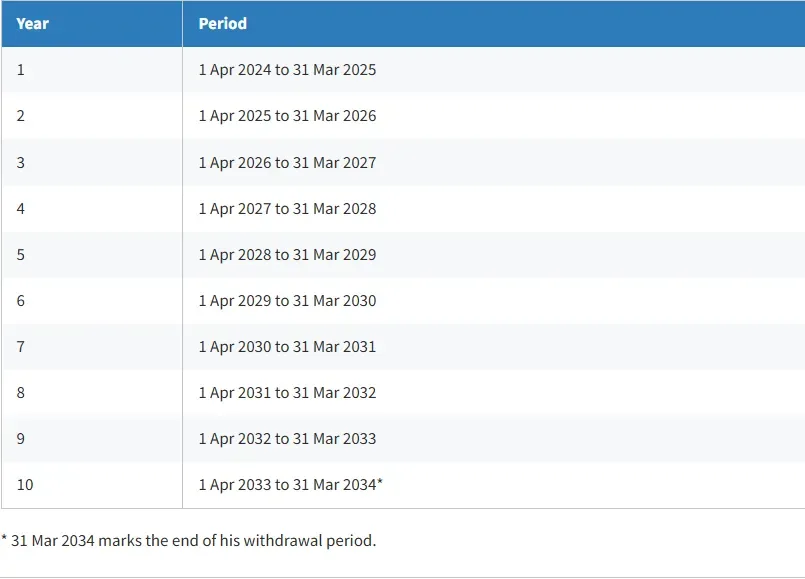
SRS member A, who commenced their initial penalty-free withdrawal on April 1, 2022, at the age of 62, falls under the statutory retirement age that was applicable when their first SRS contribution was made. They have the flexibility to distribute their withdrawals over a period extending until March 31, 2034, according to the following schedule:
Understanding taxation rules associated with withdrawing funds from an SRS account can help avoid potential penalties when planning future finances related to post-retirement life decisions. Taking into consideration all applicable laws and regulations can help ensure the proper management of financial assets while providing peace of mind during this time.
Balance in SRS account
The balance of your SRS account comprises contributions made by you and the accumulated investment returns over the years. At the conclusion of the 10-year withdrawal period, the amount held in your SRS account, excluding life annuities, will be considered withdrawn. If, at the end of the 10-year withdrawal period, you have insurance policies such as endowment policies and term annuities in your SRS account, you are not required to close your SRS account or surrender your insurance policies. The withdrawal will encompass the value of these insurance policies, determined by their surrender values set by the respective insurance companies, as well as the cash and market value of other investments held in the SRS account.
Note that: After the conclusion of the 10-year withdrawal period, the SRS operator will report 50% of the balance in your SRS account to the Inland Revenue Authority of Singapore (IRAS). This reported balance will be subject to tax in the following year. The tax liability arises because the reported balance is considered taxable income. The specific tax rate applied will depend on the prevailing tax regulations and individual income tax brackets. It's important to note that only 50% of the balance is subject to taxation, providing some degree of tax relief. To ensure compliance with tax obligations, it is advisable to consult with tax experts or financial advisors who can provide guidance tailored to your specific situation.
Investments in life annuities are unique in terms of the withdrawal rules compared to other investments in the Supplementary Retirement Scheme (SRS). Unlike other SRS investments, the 10-year withdrawal period does not apply to life annuities. Once you start receiving annuity payments, the duration of the payments will extend for the rest of your life, 50% of the annuity payments will be subject to tax each year.
The remaining balance in your SRS account following the deemed withdrawal
You have the option to withdraw the remaining balance from your SRS account. This allows you to access the funds as needed, providing flexibility and control over your investments and retirement savings. Alternatively, if you decide not to make a withdrawal, you can choose to leave the balance with the SRS operator.
By doing so, any future returns and gains generated from your investments will be subjected to the same tax treatment as any other investments. It's important to note that the tax treatment of these future returns will depend on the prevailing tax regulations and individual income tax brackets.
Just like any other investments, these returns may be subject to taxes, such as capital gains tax or dividend tax, based on the specific investment vehicles chosen within the SRS account.
Read more: Estate Planning & Retirement
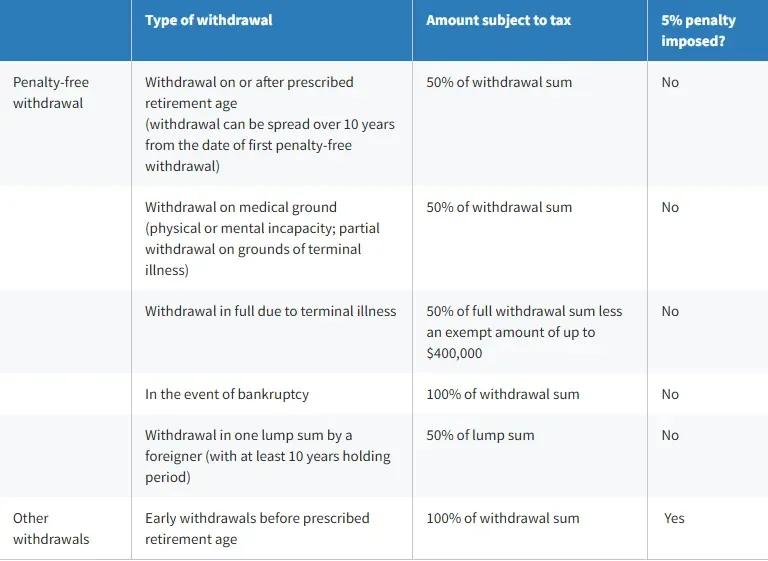
What are the Types of Withdrawals for SRS Tax Savings Account?
The types of Withdrawals are the following:
Withdrawing Funds from SRS Accounts: Tax Implications
Withdrawing funds from your SRS account can be intimidating, especially considering the taxation implications. Understanding the withholding tax on SRS withdrawals can help you make informed decisions on when and how to withdraw your funds.
When withdrawing funds from an SRS account upon reaching the prescribed retirement age, only 50% of the amount withdrawn is subject to taxation. This means that by spreading out your withdrawals over time, you may achieve greater tax savings in the long run.
In addition, if an individual is physically or mentally incapacitated due to old age or illness, they can withdraw their funds at any time and only 50% of the withdrawal will be taxed. This makes it easier for individuals in these situations to access their retirement savings without worrying about hefty taxes.
Example: Withdrawal on or after prescribed retirement age
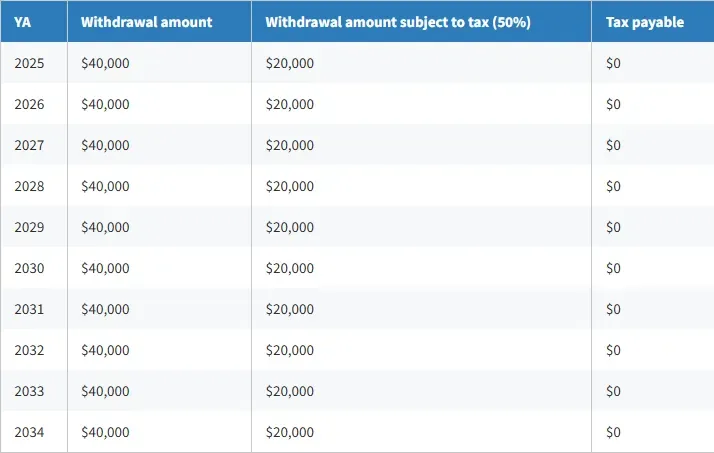
SRS member B was born on March 1, 1959. Starting from the age of 63, they no longer have any taxable income, such as employment or rental income. On April 1, 2022, at the age of 63, they made their first penalty-free withdrawal from their SRS account. The balance in their SRS account at that time was $400,000. Moving forward, they plan to withdraw their SRS funds on April 1 every year. It's worth noting that the statutory retirement age during the time of their initial SRS contribution was 62 years old.
SRS member B withdraws $40,000 per year.
When making a yearly withdrawal from the SRS account, only 50% of the amount (equivalent to $20,000) is considered as taxable income. Let's consider the Year of Assessment (YA) 2025 as an illustration. In this particular year, no tax needs to be paid on the withdrawal because the tax rate for the first $20,000 of an individual's chargeable income is zero. Thus, this tax structure allows individuals to enjoy the benefit of not paying any taxes on this portion of their SRS withdrawal.
Moreover, if a full withdrawal is made on grounds of terminal illness or death before completing 10 years' worth of SRS withdrawals (for those aged 55 years old and above), up to $400,000 may be exempt from taxation on top of the 50%. This makes it easier for beneficiaries who have inherited these accounts after the death of a loved one.
Tax Exemption for Full Withdrawal Funds from SRS on Grounds of Terminal Illness
Taxation is an important part of financial planning, and it can prove to be particularly challenging for Singaporeans who are members of the SRS. When withdrawing funds from the SRS due to terminal illness or the demise of a member, understanding the withholding tax can make all the difference.
Singaporeans who are members of the SRS scheme can obtain funds withdrawn in full on these grounds. These withdrawals are subject to a tax exemption cap of $400,000, which adjusts based on prior withdrawals made and the remaining years in the 10-year penalty-free withdrawal period. Any remaining amount after this is subject to a 50% taxation rate, with the first $20,000 exempted from taxation.
To apply for such withdrawals, an operator must submit the "Notification to IRAS of Full Withdrawal Funds from SRS on Grounds of Terminal Illness" form, which includes details about the withdrawal amount and other related information such as payment details.
Example 1: Computation for full withdrawal on terminal illness (no prior penalty-free withdrawal)
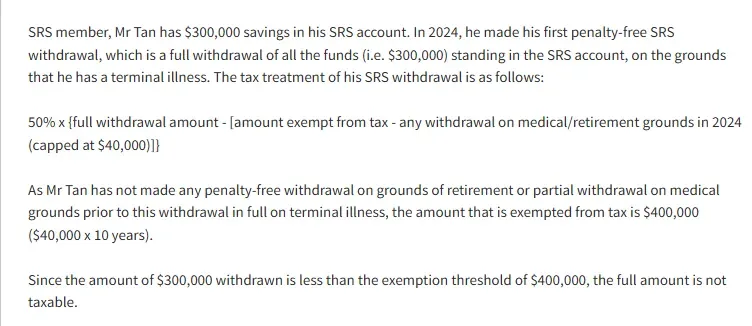
Example 2: Computation for full withdrawal on terminal illness (with a prior penalty-fee withdrawal in the past year)
SRS member, Mr Lim made his first penalty-free withdrawal of $30,000 from his SRS account on medical ground in 2023. In 2024, he made a full withdrawal of all funds standing in his SRS account (i.e. $400,000), on the grounds that he has a terminal illness.
The tax treatments of his SRS withdrawals are:
Medical ground (not full withdrawal) for Year of Assessment 2024
50% x $30,000 (i.e. $15,000) is subject to tax
Tax on first $20,000 of chargeable income is Nil. Assume that he has no other income, no tax is payable on the amount $30,000 withdrawn.
Medical ground (full withdrawal on terminal illness) for Year of Assessment 2025
50% x {full withdrawal amount - [adjusted exemption amount - any withdrawal on medical/retirement grounds in 2024 (capped at $40,000)]}
* Mr Lim first commenced his 10-year penalty-free withdrawal period in calendar year 2021. For subsequent penalty-free withdrawals after 2021, he is able to make such withdrawals (of up to $40,000 per annum tax-free if he has no other income) from 2022 to 2030 i.e. 9 remaining years of the 10-year withdrawal period. Thus, adjusted amount that is exempt from tax is $360,000 ($40,000 x 9 years).
Examples 1 and 2 compute the tax treatment associated with such full withdrawals on terminal illness. Example 1 assumes no prior penalty-free withdrawal, while Example 2 has a previous penalty-free withdrawal within the current year's assessment cycle, exclusively for medical grounds.
The amount exempted from taxes depends on whether any prior penalty-free exemptions were granted for medical/retirement purposes in the same assessment year. This percentage is determined by applying the formula 50% x {full withdrawal amount [amount exempt from tax or adjusted exemption amount any withdrawals made in said year (capped at $40,000).
For example, if Mr. Tan had not made any prior penalty-free withdrawals during the current assessment cycle, his entire $300,000 would be exempt from taxes. On the other hand, Mr. Lim's case saw a partial exemption, wherein only the portion up to the adjusted exemption threshold was exempted since he had already used up some parts previously due to medical ground withdrawals, making the remaining balance taxable at 50%.
According to applicable rules, all sums standing under deceased account holders shall be deemed removed altogether, proving greatly beneficial for their families by allowing them access to the portion they need without being subjected to additional charges involved.
Understanding withholding tax when making full withdrawals due to terminal illness or upon death helps Singaporeans maximize their savings potential—helping them plan more effectively and efficiently throughout their retirement years!
Tax Exemptions for Self-Employed Retirement Scheme Members
SRS withdrawals are subject to taxation. However, for self-employed members, there are exemptions that can be applied to reduce the amount of tax payable. Understanding these exemptions can help you make the most out of your retirement savings and ensure that you are not paying unnecessary taxes.
For a Self-Employed Retirement Scheme member, penalty-free withdrawals for medical grounds of up to $40,000 per annum are tax exempt if there is no other source of income. A full withdrawal on the grounds of terminal illness will determine the amount exempt from tax in any one year based on prior penalty-free withdrawals, capped at $40,000 per annum. The overall total exemption limit over 10 years is $400,000.
Example 1 for: Computation for full withdrawal on terminal illness (with a prior penalty-free withdrawal in the current year)
Mr. Wong, an SRS member, utilized the medical grounds provision to make his initial penalty-free withdrawal from his SRS account. In August 2024, he withdrew $50,000 due to medical reasons. Later, in December 2024, Mr. Wong made a complete withdrawal of all funds in his SRS account, which amounted to $400,000. He was eligible to do so based on the grounds of having a terminal illness.
The tax treatments of his SRS withdrawals are:
Medical ground (not full withdrawal) for Year of Assessment 2025
50% x $50,000 i.e. $25,000 is subject to tax
Medical ground (full withdrawal on terminal illness) for Year of Assessment 2025
50% x {full withdrawal amount - [amount exempted from tax - any withdrawal on medical/retirement grounds in 2024 (capped at $40,000)]}
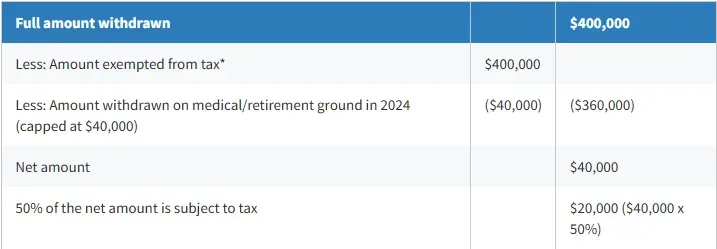
Since Mr. Wong did not make any penalty-free withdrawals for retirement or partial withdrawals for medical reasons in the years leading up to his full withdrawal due to terminal illness, the total amount of $400,000 is considered exempt from taxes. This exemption is calculated based on the withdrawal amount of $40,000 multiplied by the 10-year period.
Total amount withdrawn subject to tax for Year of Assessment 2023 is $25,000 + $20,000 = $45,000.
In the event of death without prior penalty-free withdrawal, all funds are deemed withdrawn and can benefit from the same exemption rules as long as it falls under the overall limit mentioned above ($400,000). However, if a prior penalty-free withdrawal was made before death, 50% of the higher sum between the deemed withdrawn fund or adjusted exemption amount will be taxed. Any amount below that threshold could still remain exempt from taxation depending on individual circumstances and the date of occurrence.
Example 2 for: Computation for deemed withdrawal on death (no prior penalty-free withdrawal)
SRS member, Mr Koh had $200,000 savings in his SRS account when he passed away on 8 Jan 2022. He had not made any penalty-free withdrawal on medical ground before his death.
The tax treatment of his deemed withdrawal amount of $200,000 on his death is:
50% x {full withdrawal amount - [amount exempted from tax - any withdrawal on medical/retirement grounds in 2022 (capped at $40,000)]}
As Mr Koh has not made penalty-free withdrawal on medical grounds prior to his death, the amount that is exempt from tax is $400,000 ($40,000 x 10 years).
Since the deemed withdrawal amount of $200,000 is less than the exemption threshold of $400,000, the full amount is not taxable.
We understand the importance of using your retirement savings to maximize benefits while avoiding unnecessary taxes. Our goal is to help people make informed decisions about their finances so they can enjoy themselves.
Tax Implications of Early Retirement Savings Withdrawal in Singapore
The SRS is a great way to save for retirement in Singapore and ensure that you have the funds to enjoy your golden years. However, understanding the withholding tax on SRS withdrawals is important when planning for an early retirement.
Mark, an SRS member, celebrated his 62nd birthday in 2022 and subsequently made his initial penalty-free withdrawal of $40,000 from his SRS account. In 2023, he did not make any further withdrawals due to his part-time teaching job, which provided employment income amounting to $50,000 during that year. Tragically, Mark passed away on August 1, 2024. As per the regulations, the amount of $360,000 remaining in his SRS account is considered to be deemed withdrawn upon his death. This withdrawal will be subjected to the applicable tax rules and any potential tax obligations associated with such a withdrawal. This means that any amount withdrawn by him or his beneficiary must not exceed this figure, or else it will be subject to full taxation.
The tax treatments of his SRS withdrawals are:
Withdrawal on grounds of retirement for Year of Assessment 2023
50% x $40,000 (i.e. $20,000) is subject to tax
Tax on the first $20,000 of chargeable income is Nil. Assume that he has no other income, no tax is payable on the amount $40,000 withdrawn.
Deemed withdrawal upon death for Year of Assessment 2025
50% x {amount deemed withdrawn - [adjusted exemption amount - amount withdrawn on medical ground/retirement in 2024 (capped at $40,000)]}
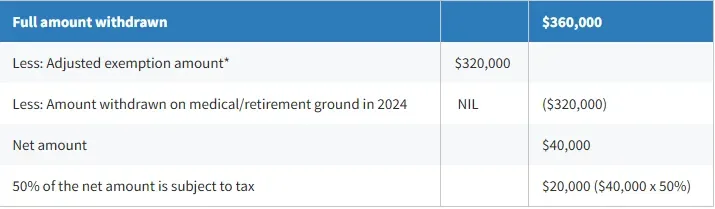
Mark began his 10-year withdrawal period in 2020. Unfortunately, he passed away on August 1, 2022, leaving 8 more years remaining in the withdrawal period (spanning from 2022 to 2029). In this case, the adjusted exemption amount stands at $320,000, which is calculated by multiplying his initial withdrawal amount of $40,000 by the remaining number of years, which is 8.
If Mark wishes to withdraw from his SRS account due to bankruptcy, then he can request for 100% of the sum withdrawn, subjecting it fully taxable, but no early withdrawal penalty applies here. Foreigners with at least a 10-year holding period may also request for 50% of their savings completely withdrawn without any penalty being imposed upon them.
Prior to age 62 (the prescribed retirement age), withdrawals are subject to full taxation, and an additional 5% penalty applies, which is not the case with annuity payments made before account closure, which are tax-free if no SRS withdrawals have been made after that point.
Qualifying individuals may also apply for investment withdrawals from their accounts without liquidating their investments, although these still remain fully taxable upon completion of the 10th-year mark of the early withdrawal period, and withholding taxes do not apply to Singaporean account holders' withdrawals either.
To ensure successful retirement planning, it is essential that one understands all aspects, including taxation laws related to SRS accounts, so as to maximize one's income through the proper utilization of these accounts in the long run!
Withdrawal in the event of bankruptcy
If you find yourself in a state of bankruptcy, you have the option to apply for the withdrawal of your SRS savings. It's important to note that in such cases, 100% of the withdrawn amount is subject to tax. However, the penalty for early withdrawal does not apply in these circumstances.
The SRS operator needs to submit the Application for Penalty-Free Premature Withdrawal of Funds from SRS Account upon Bankruptcy.
Withdrawal of lump sum by a foreigner (with at least 10-years holding period)
As a non-Singapore Citizen or Permanent Resident, you have the opportunity to apply for penalty-free withdrawal of your SRS savings.
Additionally, if you satisfy the following criteria, 50% of the withdrawn amount will be fully subjected to tax:
You were not a Singapore Citizen or Permanent Resident on the withdrawal date and for the preceding 10 years without interruption.
You have maintained an SRS account for a minimum of 10 years, starting from the date of your initial SRS contribution.
You choose to make a single, full withdrawal from your SRS account.
Withdrawal before prescribed retirement age
You have the flexibility to withdraw your SRS savings at any time. However, it's important to note that early withdrawals are fully taxable and carry a 5% penalty.
To handle the penalty on early withdrawals, the SRS operator will assist Singapore Citizens by completing Form PMP. For Singapore Permanent Residents and foreigners, Form IR37B will be completed instead. These forms are conveniently available as the S45 Offline Data-Entry Import Template.
Example of Early Withdrawal
SRS member C was born on March 1, 1963. From the age of 60 onwards, C did not have any taxable income, such as from employment or rental. At the age of 61, starting from April 1, 2024, C decided to withdraw his SRS funds annually on April 1. At the time of withdrawal, C had a total of $400,000 in his SRS account. It's worth noting that the statutory retirement age in effect during C's initial SRS contribution was 62.
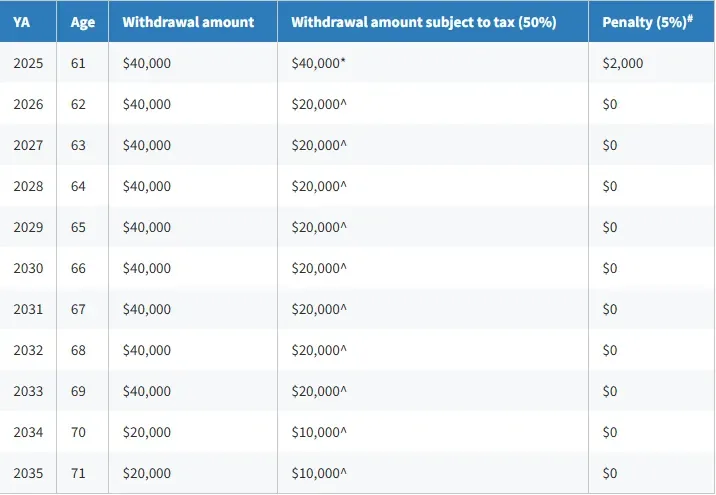
# 10-year penalty-free retirement withdrawal period starts from age 62 (i.e. YA 2024 to YA 2035).
* As the withdrawal at age 61 is an early withdrawal, 100% of the amount withdrawn is taxable. In addition, a 5% penalty is applicable.
^ Only 50% of the withdrawal amount is regarded as taxable income as he withdrew the amount after attaining the age of 62 years.
Annuity payments
If you do not make any SRS withdrawals, annuity payments made to your SRS account before it is closed or deemed closed will not be subjected to tax. However, once the SRS account is closed or deemed closed, 50% of the annuity payments will be subject to taxation.
It's important to note that the SRS account is considered to be closed at the 10th year of the 10-year withdrawal period.
Withdrawals in the form of investments
SRS members who meet the necessary criteria have the option to request their SRS operators for non-liquidating withdrawals from their SRS accounts. This allows them to withdraw their investments without having to sell their assets.
The following types of withdrawals are eligible for penalty-free options:
Withdrawal on or after the prescribed retirement age, which corresponds to the statutory retirement age at the time of the SRS member's initial contribution.
Withdrawal based on medical grounds.
Full withdrawal by a foreigner who has maintained their SRS account for a minimum of 10 years since their first contribution.
Actual withdrawal from an SRS account that is considered to be closed, such as after the completion of the 10-year withdrawal period or in the event of the SRS member's demise.
SRS Withdrawals: Tax Implications and Conditions
The SRS is a great way for individuals to save for their retirement and enjoy tax benefits. However, there are certain tax implications that must be taken into consideration when making withdrawals from the SRS account.
Let's start by discussing the withholding tax rate.
For Singaporean account holders making SRS withdrawals, no withholding tax is imposed on the withdrawn amount. However, if a foreigner or Singapore Permanent Resident (SPR) applies to withdraw cash or investments from their SRS account, a withholding tax will be applicable. The percentage of the withdrawn amount subject to withholding tax varies depending on the type of withdrawal, either 50% or 100%.
The SRS bank operator will carry out the following steps:
Withhold the tax amount at the prevailing non-resident tax rate, which is currently 24% (reduced to 22% for withdrawals made between 1 Jan 2016 and 31 Dec 2022). This tax amount will be remitted to IRAS.
Deduct a 5% penalty on any premature withdrawals separately from the withholding tax. Please note that this penalty is non-refundable.
Electronically transmit the withdrawal information to IRAS and make the necessary payment of the withholding tax.
Example of Computation of withholding taxes
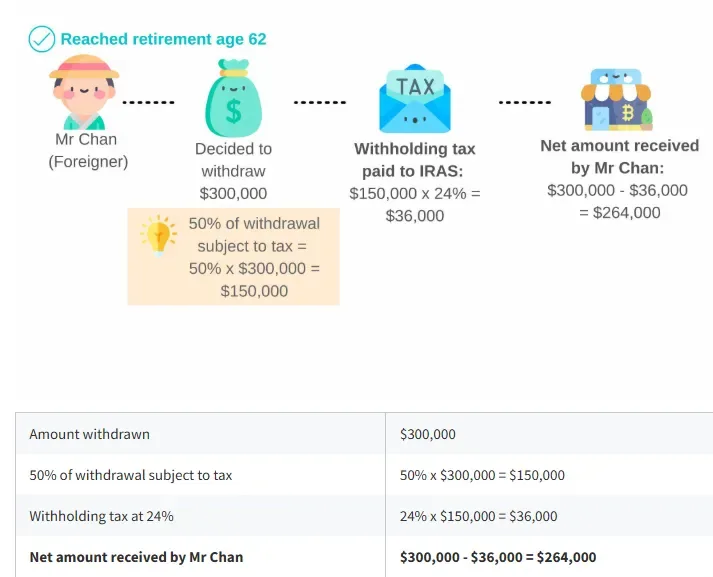
scenario 1:
Mr Chan (a foreigner) made a withdrawal of $300,000 from his SRS account in 2024 after his retirement age.
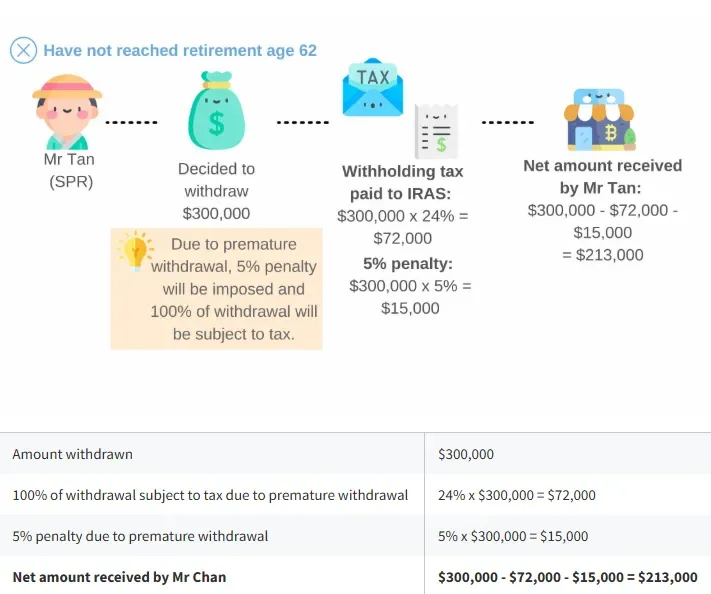
Scenario 2:
Mr Tan (an SPR) made a withdrawal of $300,000 from his SRS account in 2024 before his retirement age, which resulted in a 5% penalty imposed.
This is good to note that in Concessionary Withholding Tax Rate of 15% will apply if the following conditions are met:
The total amount withdrawn from their SRS account in a given calendar year should not exceed $200,000.
The individual must not have any other sources of income apart from the SRS withdrawal(s) during the same calendar year in which the withdrawal(s) occur.
To enjoy this concession, the SRS account holder is required to declare their fulfillment of these two conditions by completing Form IR37B (1). This form can be obtained from the SRS operator.
Withholding tax is not the final tax payable
If the foreigner or Singapore Permanent Resident (SPR) is considered a tax resident of Singapore, the actual tax amount payable for the SRS withdrawal will be calculated based on the progressive resident rates.
However, for non-residents, the actual tax amount payable on the SRS withdrawal will be either 15% or the progressive resident rates, whichever is higher.
Applying for a refund
The tax withheld on your SRS withdrawal serves as a tax credit, which will be utilized to offset your actual tax liability. If there are any remaining unused tax credits, they will be refunded to you.
To ensure that your actual tax liability is accurately calculated and any unused tax credits are refunded, please remember to file an Income Tax Return within the e-Filing period, which typically runs from 1st March to 18th April of the year following the year in which the tax was withheld. You can conveniently complete this process through the myTax Portal.
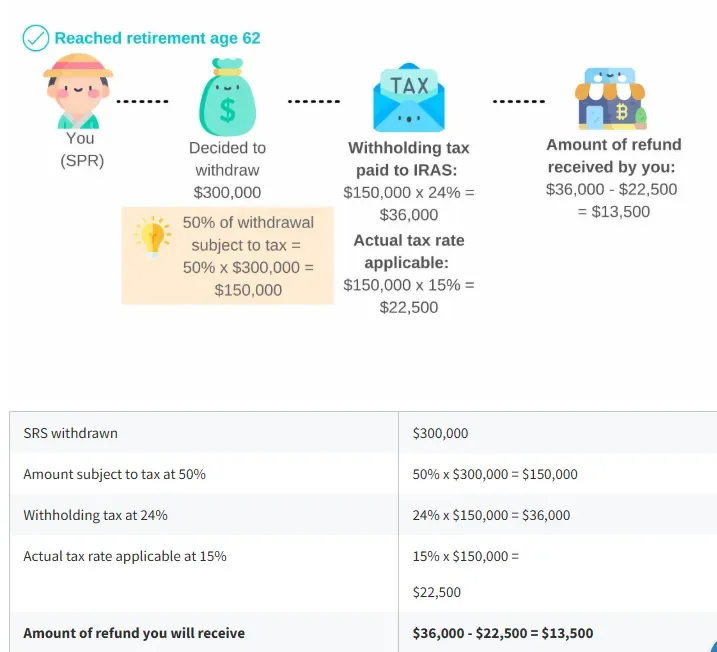
Example of Computation of refund
If we assume that the final tax rate applicable for the SRS withdrawal is determined to be 15% and you do not have any other tax obligations, the calculation for the refund you will receive (for the withholding tax paid in 2024) is as follows:
If you are a foreigner or a Singapore Permanent Resident and you are leaving your employment in Singapore, and you have made a withdrawal from your SRS account in the year of your departure, it is required for you to obtain a SRS statement of contributions/withdrawal from the SRS bank operator. This statement is specifically needed for tax clearance purposes.
Important Considerations for Nominating a Beneficiary for an SRS Account
Nominating a beneficiary for an SRS account is an important consideration as SRS savings are meant to be used exclusively by the members themselves. If they pass away, their balances will form part of their estate and can be distributed according to either their will or applicable law.
When it comes to taxation on SRS withdrawals, there is no 5% penalty on withdrawal from an SRS account in cases of death. Instead, only 50% of the sum standing in the SRS account after deducting any exempt withdrawals upon death will be subject to income tax. This means that the remaining 50% may help reduce potential inheritance taxes that could arise from other assets owned by the deceased at the time of death.
In addition, bank operators may require documentation like Grants of Probate or Letters of Administration before releasing funds belonging to deceased members' estates. So make sure you have this ready before making a claim! All these measures need to be taken into consideration when nominating a beneficiary for your SRS account and planning for retirement beyond finances. With careful thought and planning, your loved ones can continue living even after your passing away.
Bottom Line
SRS is a great way to prepare for retirement. It is important to understand the rules and regulations associated with SRS withdrawals, as well as the potential tax implications they may have. It is also beneficial to know about the exemptions and deductions available for self-employed members, as well as special cases such as terminal illness or death of a member. By taking all of this into consideration, you can make informed decisions on when and how to withdraw your funds from your SRS account in order to maximize your savings potential.
Frequently Asked Questions
1. As a foreigner who began contributing to the SRS at the age of 55, can I withdraw my SRS contributions penalty-free at the age of 62. Do I need to wait for 10 years before making a penalty-free withdrawal?
Ans. Any SRS member, regardless of whether he is a foreigner or not, may withdraw his SRS without penalties at the age of 62, if that is the statutory retirement age prevailing at the time of his first contribution.
2. What is the reasoning behind permitting the withdrawal of investment products for the four specific types of withdrawal that qualify for the 50% tax concession?
Ans. This is to allow SRS members to hold their SRS investments outside of the SRS scheme without having to incur the transaction costs to first liquidate their SRS investments (so as to withdraw cash from their SRS accounts) and thereafter re-purchase the same investments outside of the SRS scheme.
3. Is it possible for me to designate a beneficiary for my SRS funds?
Ans. No. We do not have a provision in the SRS allowing for the nomination of a beneficiary of an SRS account. This is because SRS savings are meant for the SRS members’ own retirement purposes. However, if the SRS member passes away, the SRS balances will form part of his estate and will be distributed according to his will or the law (if a will does not exist). There will be no 5% penalty on withdrawal and only 50% of the sum standing in the SRS account after deducting the amount of deemed withdrawal upon death that is exempt from tax will be subject to income tax.
Please also note that SRS bank operators may require the Grant of Probate or Letters of Administration to be produced by the executor or administrator of the estate to ensure that the assets in the SRS are distributed correctly.
See your own figures
The free calculators show what an SRS contribution does to your income tax, and what your retirement will cost.
A question about what you just read?
Ask here and a licensed adviser from our panel will reply within one business day. Introductions are free, and SRS.SG does not receive commissions or referral fees.