In this article (18 sections)
Singapore's personal income tax system can be complex and confusing, especially for those who are new to the country. As a Singapore permanent resident or non-resident, it is important to understand how the tax system works and what your obligations are.
Planning a move? Our panel partner IB Consulting assists with Singapore PR and citizenship applications.
In this blog, we will provide you with a comprehensive guide to Singapore's personal income tax system. We will cover topics such as tax residency, personal income tax rates for residents and non-residents, differences between the two, and how to calculate your taxes. We'll also delve into tax treatment of overseas income and employer benefits, personal income tax reliefs and deductions, and steps to filing your taxes in Singapore.
Lastly, we'll discuss the consequences of not paying your taxes on time. Read on to get a better understanding of how Singapore's personal income tax system works.
Personal Income Tax Rates in Singapore
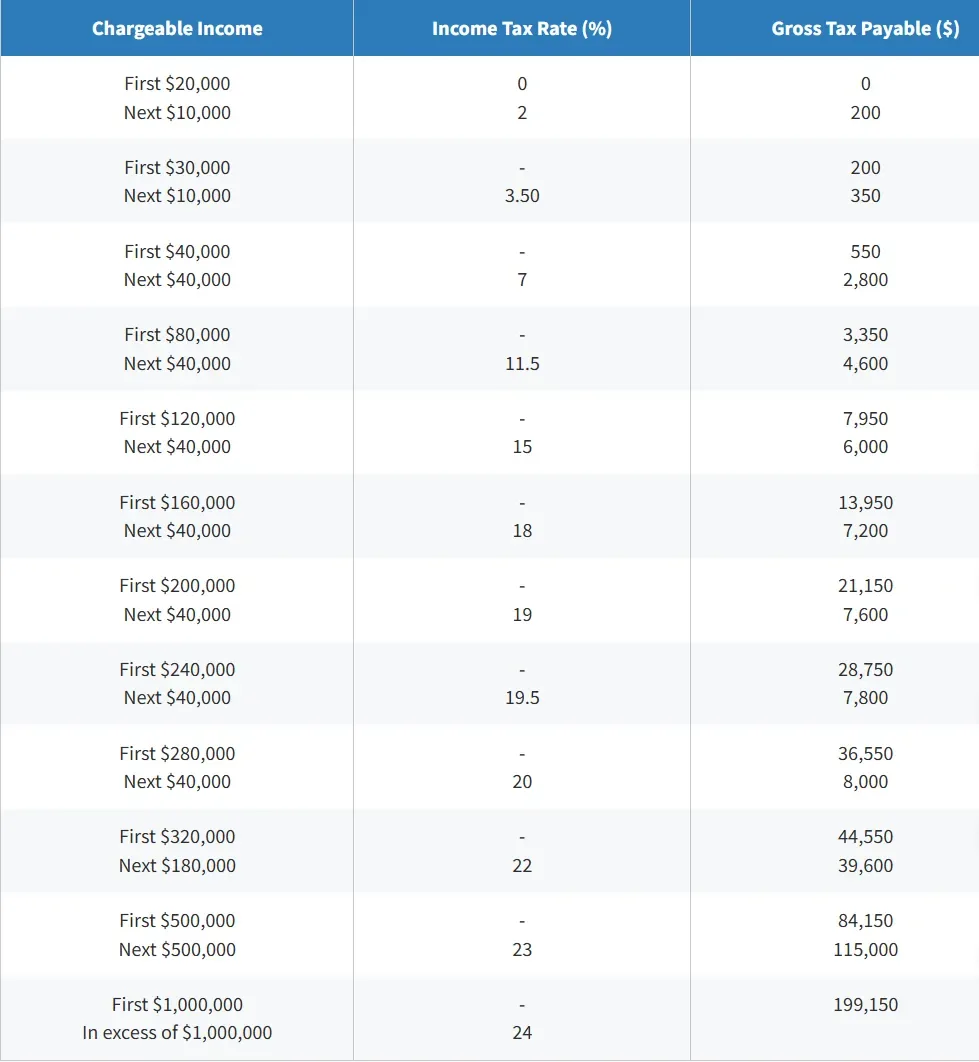
Personal income tax in Singapore is progressive: income is split into bands, and only the slice of income falling inside each band is taxed at that band’s rate. For tax residents the bands run from 0% up to 24%. For people from other countries living in Singapore, how much tax they owe depends on whether they're considered residents for tax purposes.
The top of the table was raised from Year of Assessment 2024. Chargeable income between S$500,000 (approx, US$370,000) to S$1 million will be taxed at 23 percent, while chargeable income in excess of S$1 million (approx, US$741,000) will be taxed at 24 percent. This change will affect both the highest-earning residents in Singapore and non-residents (except those under employed), bringing their tax rate to 24%.
Read more: A Comprehensive Guide to SRS withdrawal and tax saving essentials
Tax Rates for Residents
Residents in Singapore are subject to a progressive tax rates structure, with rates ranging from 0% to 24% this 2024. These rates are applied to chargeable income on a yearly basis and are segmented into different income tax bands. Filing of individual income tax return for tax resident is compulsory if your annual income is S$20,000 or more. Tax residents do not need to pay tax if your annual income is less than S$20,000. However, you may still need to file a tax return if you have been informed by
Singapore tax authority to submit your tax return. Furthermore, earned income relief is also given to further reduce the tax payable based on age.
Resident Tax Rates from Year of Assessment (YA) 2024 Onwards
Source: IRAS
Tax Rates for Non-Residents
If you are a foreigner who spent less than 183 days in Singapore during the tax year, you are considered a non-resident. Your taxable income may vary as a non-resident in the following ways:
If you are here on a short-term basis for 60 days or less in a year, your employment income is tax-free. This exemption does not apply if you are a corporate director, a public entertainer, or practice a profession in Singapore. Foreign specialists, foreign speakers, queen's counsels, consultants, trainers, and coaches are examples of professionals.
If you spend 61-182 days a year in Singapore, you will be taxed on any income made there. You can deduct expenses and donations from your taxes. Personal reliefs, however, are not available to you.
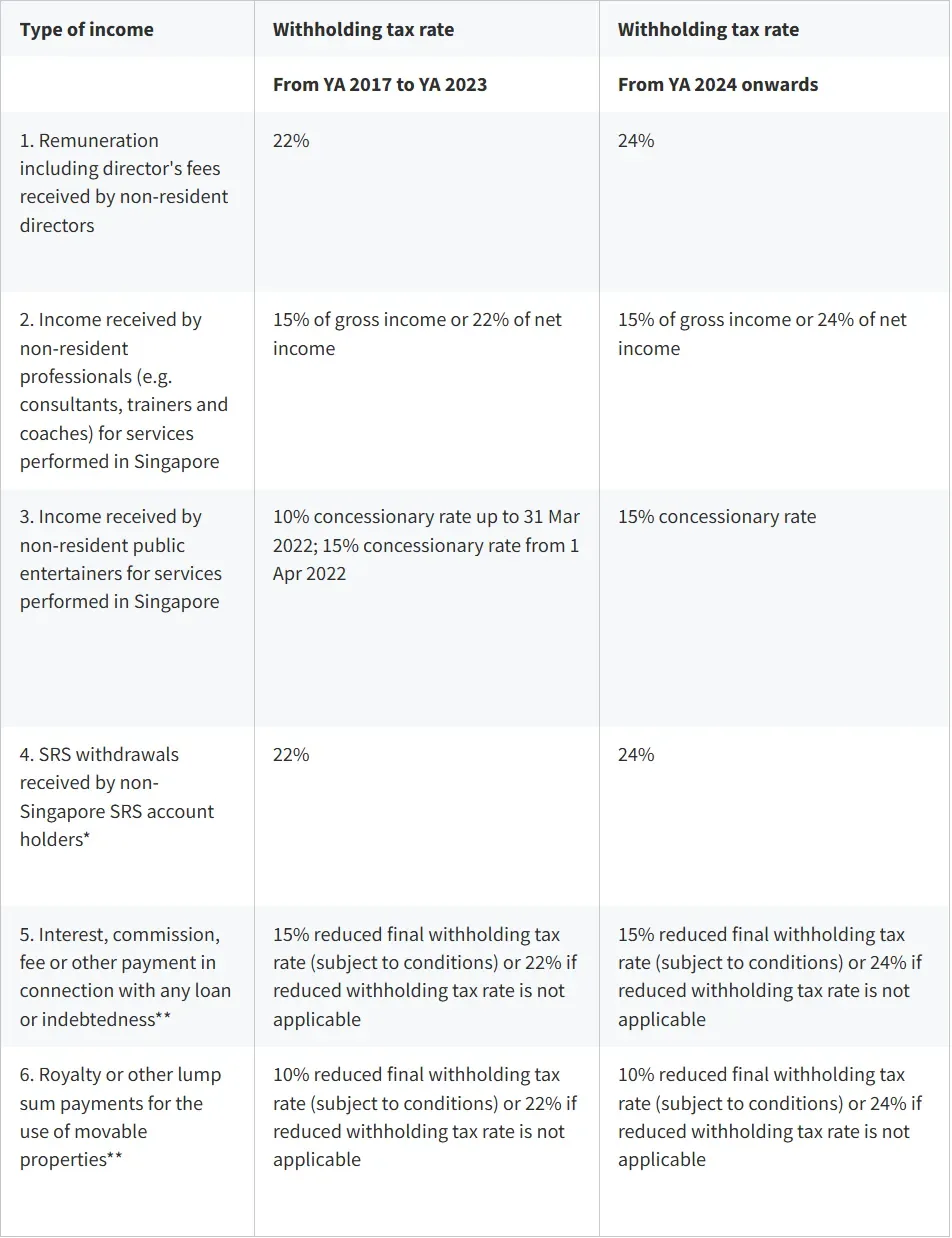
From Year 2024, director and remuneration fees, consultancy fees, and all other income are taxed at a rate ranging from 22% to 24% (except on employment income and certain income taxable at reduced withholding rates).This is to maintain parity between the income tax rate of non-resident individuals and the top marginal income tax rate of resident individuals.
Taxes on Employment Income
Non-resident employment income is taxed at a flat rate of 15% or at the progressive resident tax rates (see table above), whichever is higher tax amount.
Withholding taxes on income of non-resident individuals
A certain non-resident income is liable to withholding tax when it is due and receivable. The applicable withholding tax rate is determined by the type of income earned and the YA involved.
Source: IRAS
Difference between Tax Residents and Non-Tax Residents
If you earn a moderate or lower income and live mostly in Singapore, becoming a tax resident could be financially beneficial. If your yearly earnings range from S$320,000 to S$400,000, being a tax resident can reduce your tax payments.
Moreover, if you often travel outside Singapore, it's important to keep count of the days you spend in the country for tax purposes.
Being mindful of your time spent here helps determine your tax responsibilities accurately.
Interesting article to Read: Importance of Dividends in Singapore
Tax treatment of income earned overseas
Foreign income received in Singapore on or after January 1, 2004 is not taxable. This includes foreign earnings deposited into a Singapore bank account. You do not have to report non-taxable foreign income.
However, there are some conditions in which offshore income is taxable:
It is received in Singapore through Singapore partnerships.
Your abroad work is unrelated to your Singapore work. That is, as part of your job here, you must travel internationally.
You are working for the Singapore government outside of Singapore.
In your tax return, you must state eligible taxable foreign income under 'employment income' and 'other income' (whichever is relevant).
Tax treatment of employer benefits
Any earnings and profits you receive from your job are usually subject to tax, unless there are specific exemptions or concessions. This includes all types of benefits, whether they're in the form of money or something else, provided to you because of your job. Here are some examples of benefits that are taxable when received from your employer:
Car provided by employer,
Reimbursements of medical and dental treatments for dependants other than yourself, your spouse and children.
Overtime payments,
Per diem allowances (daily allowance given to employees on overseas trips, out of Singapore, for business purposes), provided the amount is in excess of acceptable rates.
Fixed monthly allowance for transport or if mileage on private cars are reimbursed.
Fixed monthly meal allowance.
Residential accommodation.
Share options.
However, some non-cash advantages (for example, accommodations) are taxed using unique formulas, resulting in lower taxation on these benefits-in-kind. Thus, a correctly structured remuneration package for executives (i.e. salary plus benefits in kind) might help lower their individual tax burden in Singapore.
Read more: 5 Tips for Getting the Most out of Your SRS Account
How To Calculate Personal Income Tax?
Income becomes subject to tax when it's earned or comes from Singapore, regardless of whether the person lives there. If income comes from outside Singapore, it's only taxed if a resident individual receives it in Singapore through a partnership based in Singapore.
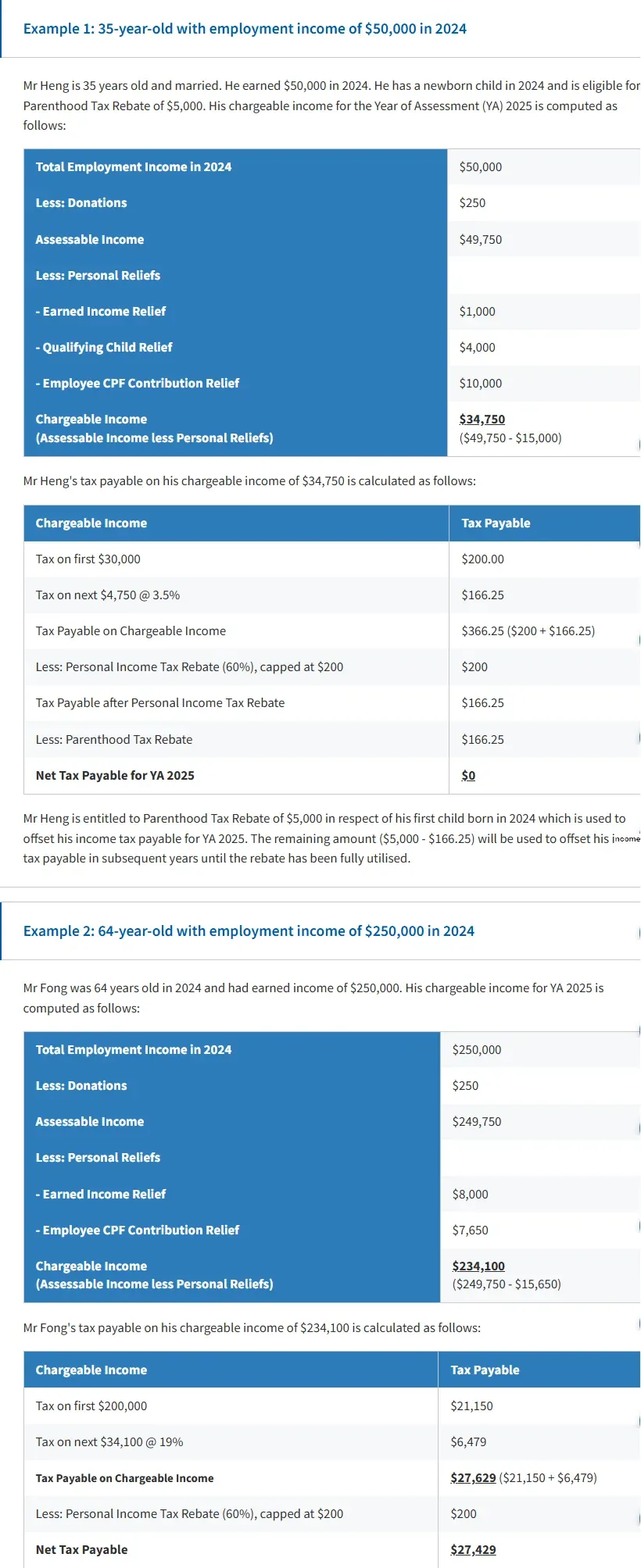
Taxes are calculated based on your chargeable income, the chargeable income (i.e. income subject to taxation) for tax residents is determined as below:
Wherein,
Total income means
gains or profits from carrying on any business, trade, profession or vocation either as a sole proprietor or partner in a partnership.
gains or profits from any employment.
dividends, interests, investment income.
rents, royalties, premiums and other profits arising from properties.
exclude qualified income earned overseas (more details provided later in the guide).
Expenses means
qualified employment related expenses,
qualified rental related expenses.
Donations means
donations to qualified charitable organisations.
Personal Reliefs means
special personal reliefs such as eligible course fees, earned income relief, parent relief, etc.
Chargeable income is the adjusted income that remains after deductions from total income (as illustrated in the image above).
Read more: Expanding Opportunities: Plan for New SRS products for Investors to Grow Retirement Funds
Personal Income Tax Reliefs and Deductions
Sometimes, we wonder why our tax bill seems high? It could be because you haven't taken advantage of the various tax reliefs and deductions offered in Singapore. There are ways to reduce the amount you owe, and these reliefs might be the key to lowering your tax burden.
For Singapore Residents, some common forms of tax relief include:
Business expense deductibles,
Personal Relief ( parent/grandparent, spouse/child, handicapped relative, etc)
Pursuing education ( course fee relief )
Charitable donations,
Employment expense deductibles.
Singapore's tax laws offer numerous programs aimed at supporting particular social causes and business initiatives while also aiding underprivileged communities. That's why keeping detailed financial records is important. By doing so, you ensure that you don't miss out on any opportunities to claim benefits or support that these schemes offer, making sure every cent is accounted for.
Read more: 6 Retirement Annuity Plan in Singapore
Filing Personal Income Taxes in Singapore
Filing your tax return is an annual responsibility for eligible taxpayers in Singapore. Completed forms must reach the tax authority by April 15th.
Tax residents earning less than S$22,000 annually are exempt from paying taxes. However, if the tax authority requests you to submit your tax form, even with no income in previous years, you still need to declare zero income and submit your form by April 15th (paper) or April 18th (e-filing). Mandatory filing applies if your annual income is S$22,000 or more.
You have the option to file online or by mail. The appropriate form of paper tax is sent upon request, while the online form is available from March 1st each year.
Tax resident individuals use Form B1,
self-employed individuals use Form B,
and non-resident individuals use Form M.
Penalties may apply for late filing or failure to file. The tax authority may take legal action for non-filing or non-payment of tax.
Upon filing, you'll receive your Notice of Assessment or tax bill between May and September, indicating the tax amount due. If you disagree with the tax assessed, you must notify the Singapore tax authority within 30 days of receiving your tax bill, stating your reasons for objection.
Regardless of objections raised, the full tax amount must be paid within 30 days of receiving the Notice of Assessment. Failure to do so incurs penalties, even if you've informed the tax authority about your objections.
Read more: 12 Mistakes in Retirement Planning You Should Avoid
What Happens If I Don't Pay My Taxes in Singapore?
Ignoring tax payment in Singapore can have serious consequences. Non-payment can lead to penalties and interest charges, affecting your tax residency status. Avoiding taxes may result in legal action by the tax authority, increasing your tax liability over time.
Conclusion
Understanding Singapore's personal income tax system is important for residents and non-residents alike. By familiarizing yourself with the basics of the tax system and determining your tax residency, you can accurately assess what you owe. It's important to know the different tax rates applicable to residents and non-residents, as well as the tax treatment of income earned overseas and employer benefits.
To calculate your individual income tax rates, consider the various reliefs and deductions available to you. Then, follow the necessary steps for filing your taxes, from preparation to post-filing processes. It's essential to fulfill your tax obligations to avoid potential consequences. If you have any queries or require assistance with your personal income taxes in Singapore, consult with a professional tax advisor.
They can provide guidance tailored to your specific circumstances and ensure compliance with Singapore's tax regulations.
Read more: Why is Investing Important?
Frequently Asked Questions
1. I live in Singapore and work as a consultant for a multinational corporation. Is my earnings taxable?
Yes. Even if your employer is not a Singapore resident or your income is not paid in Singapore, you will be taxed on your income (at resident rates) received during the period you provided consulting services in Singapore.
2. Can a Singapore employee who stays for fewer than 183 days be taxed as a resident?
That depends on the situation. If you work as a sales consultant for a Singapore company and spend less than 183 days here due to frequent business trips, you would still be taxed as a resident. However, if you are assigned to an offshore project for several months and spend less than 183 days in Singapore, you will be taxed as a non-resident.
3. What is the due date for personal income tax filing in Singapore?
The personal income tax filing deadline in Singapore is 15 April. Singapore follows a calendar year basis for personal taxes.
4. Who is liable to file a personal tax return in Singapore?
Every individual, both tax residents and non-tax residents, is required to submit a separate tax return on all income, including gains or profits from a trade or profession and earnings from employment, each calendar year.
If a non-tax resident works for fewer than 60 days. Short-term employment income is tax-free. If you are a company director, a public entertainer, or practice a profession in Singapore, the 60-day rule does not apply to you.
5. If my company pays for my accommodations, will there be tax consequences for me?
Yes, this perk falls under the category of benefits-in-kind, which refers to non-cash benefits received by employees from their employers. Many of these perks, however, are taxed at a lower rate.
6. Are gains incurred on stock investments taxable?
As an employee, you may earn share options as a result of any office you hold (e.g., director or external auditor), or you may own or purchase shares in the company or its parent company through share awards and other similar employee share purchase programs. Gains from such advantages are taxable.
See your own figures
The free calculators show what an SRS contribution does to your income tax, and what your retirement will cost.
A question about what you just read?
Ask here and a licensed adviser from our panel will reply within one business day. Introductions are free, and SRS.SG does not receive commissions or referral fees.