In this article (16 sections)
Are you looking for ways to maximize your retirement savings? Singapore's Supplementary Retirement Scheme (SRS) can be a great way to save for retirement while taking advantage of tax savings.
In this blog post, we will discuss the benefits of contributing to SRS, tax planning strategies for SRS withdrawals, and how to make the most of your SRS funds with investment options. We will also provide a general information disclaimer.
So, if you're looking to make the most of your retirement savings, this post is for you!
Benefits of Contributing to Singapore's SRS
Are you curious about Singapore's SRS and the potential benefits it offers?
The Supplementary Retirement Scheme (SRS) was introduced in 2001 to encourage individuals to voluntarily save for retirement, and since then, 140,000 accounts have been opened with $8 billion contributed. This scheme provides tax relief benefits from contributions as chargeable income is reduced dollar for dollar up to a maximum of $15,300 per year.
Individuals can open an SRS account online through DBS, OCBC, and UOB banks. The nominal interest rate is 0.05% per annum, but there are tax relief benefits from contributions as chargeable income is reduced dollar for dollar up to a maximum of $15,300 per year.
Most individuals contributing to an SRS account have an assessable yearly income of more than $80,000, which means they stand to benefit even more from this scheme while those earning less need not exceed the Income Tax Relief Cap of $80,000 for Year of Assessment 2018/2019 when making their contribution.
Here is a quick summary of how much money you can save.
Should you make an SRS contribution?
The "IRAS" formula (Income, Relief, Allocate, Set aside) is a big help in determining whether you should contribute to the SRS. Let's explain this further.
INCOME: What is your current income level?
Typically, individuals who contribute to the SRS have an annual assessable income of $80,000 or higher. It's worth noting that the higher your income, the greater your potential tax savings when making SRS contributions.
RELIEF: How much existing tax relief do you have?
Starting from the Year of Assessment 2018, there is a personal income tax relief cap of $80,000. Since SRS contributions are non-refundable, it is crucial to ensure that your existing tax relief, including reliefs such as the working mother's child relief (WMCR), does not surpass this cap.
ALLOCATE: What is the maximum contribution you can make?
For citizens and permanent residents, the maximum allowable contribution to the SRS is $15,300.
SET ASIDE: How long are you willing to keep your funds in the SRS?
It's important to note that early withdrawals made before reaching the age of 62 will incur a 5% withdrawal penalty. Therefore, carefully consider and make sure that you are willing to commit the funds until the age of 62, especially if you are a citizen or permanent resident saving for retirement.
By using this "IRAS" formula as a guide, you can make an informed decision about contributing to the SRS that aligns with your income level, existing tax relief, maximum allowable contribution, and willingness to keep the funds aside for the specified period.
Foreigner SRS accounts: Differences to be aware of!
ALLOCATE: You have the option to contribute a maximum of $35,700 per year to your SRS account.
SET ASIDE: It is important to maintain your SRS account for a minimum duration of 10 years from the date of your initial contribution. To prevent any withdrawal penalties, it is advisable to withdraw the entire amount in a single transaction.
Meanwhile, 50% of the amount is still subject to tax. You can find more information here SRS withdrawal and tax saving essentials: A Comprehensive Guide
How does the withdrawal process function once you reach the age of 62?
Once you reach the age of 62, you have the option to make withdrawals from your SRS account over a period of ten years, starting from the date of your initial penalty-free withdrawal. For instance, if you begin making withdrawals at age 63, you must complete them by age 72. Alternatively, you can choose to commence withdrawals at a later age, such as 65, and complete them by age 74.
It's worth noting that upon the expiration of the 10-year withdrawal period, there is no requirement to close your SRS account or sell any of the investments held within it. Instead, the remaining funds and the market value of other investments in your SRS account will be considered withdrawn at the end of the 10th year.
However, it's important to highlight that the 10-year withdrawal period does not apply to investments in life annuities. If your SRS account remains open, your monthly annuity payouts will be returned to the SRS account before you can withdraw them.
On the other hand, if your SRS account is closed, your monthly annuity payouts may be paid directly into your bank account, but 50% of the amounts received will still be subject to tax. This unique characteristic of the SRS withdrawal process opens up various planning strategies for individuals to consider.
Read more: Tips To Maximize SRS
After age 62, how are SRS withdrawals taxed?
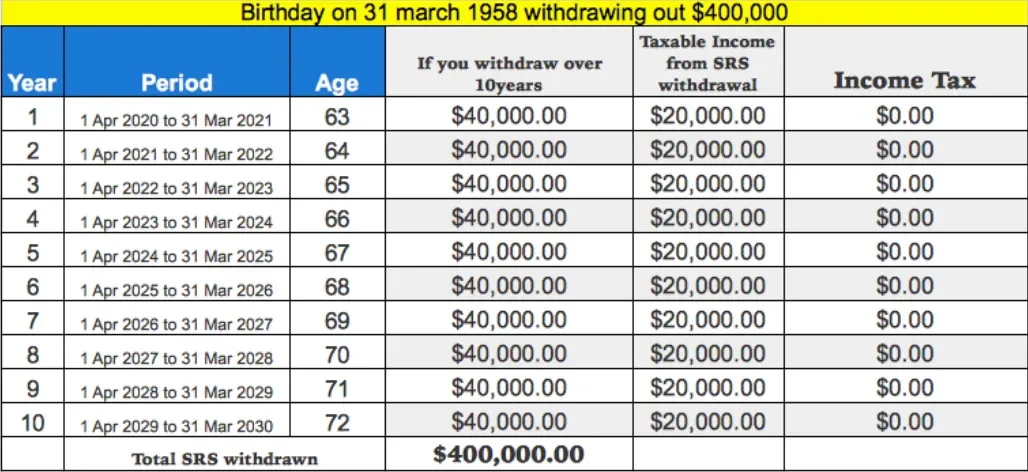
When making withdrawals, 50% of the amount will be considered as taxable income. However, according to the current tax rates, any amounts that are $20,000 or less are tax-free. With this in mind, a strategic approach would be to withdraw only $40,000 per year, with 50% of that amount being considered taxable income. This ensures that the taxable portion becomes tax-free, providing potential tax advantages.
This withdrawal strategy can be spread out over a period of 10 years, as illustrated below.
What happens if you have rental income and/or an SRS account that has accumulated to $1 million?
These important aspects are often overlooked when discussing these matters.
Firstly, it's crucial to note that rental income is considered personal income and is subject to taxation. When you receive income from your rental properties, it adds to your total income, including any income from your SRS account.
Secondly, let's consider the potential growth of an SRS account. If you consistently contribute $15,300 into your SRS account for a period of 30 years and achieve an annual investment return of 5%, you would be able to build a substantial pot amounting to $1,016,514.
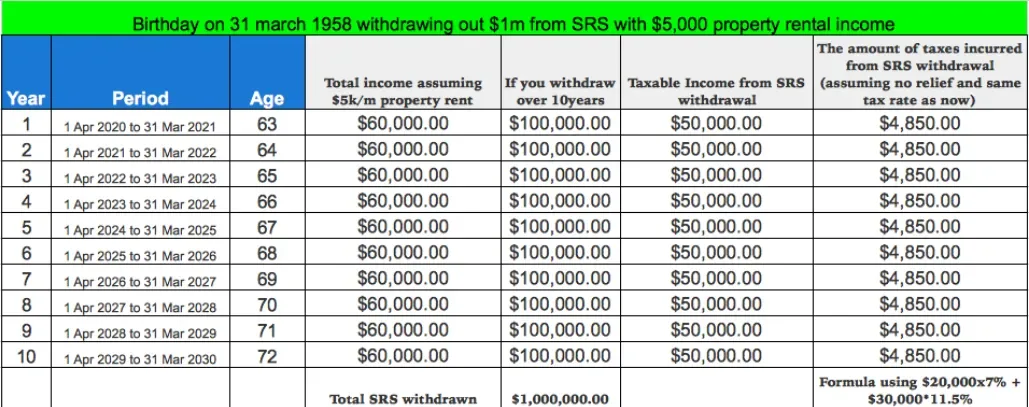
These two factors contribute to making the situation described possible. It's important to note that certain portions of your SRS withdrawals will be subject to taxation.
However, it's worth highlighting that the taxation is deferred until you reach the age of 63 and above. This deferral provides a potential advantage for long-term financial planning.
Things to think about:
Is it likely that the initial tax-free threshold of $20,000 will remain unchanged after 30 years? Considering inflation and the potential decrease in the purchasing power of $20,000 over time, it is possible that the tax-free zone may be increased. What if the tax-free threshold were raised to $50,000?
If there is rental income involved, would it be more advantageous to strategically spread-out SRS withdrawals using an annuity? This approach could help optimize the tax implications and provide a more stable income stream, considering the fluctuation in rental earnings.
To receive tax relief, should I top up my CPFSA or SRS through RSTU?
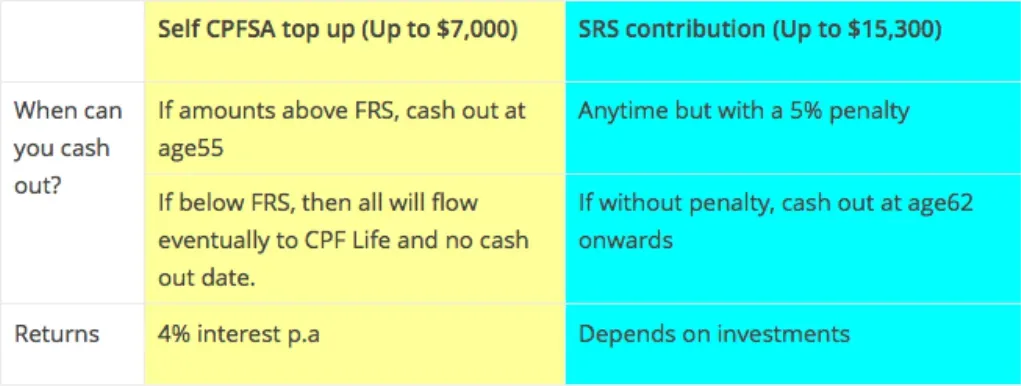
This common problem frequently affects a lot of people. It is worthwhile thinking about applying both strategies if you have enough funds saved up and haven't already reached the $80,000 relief maximum.
Now, let's have a quick summary of the main differences between the two solutions.
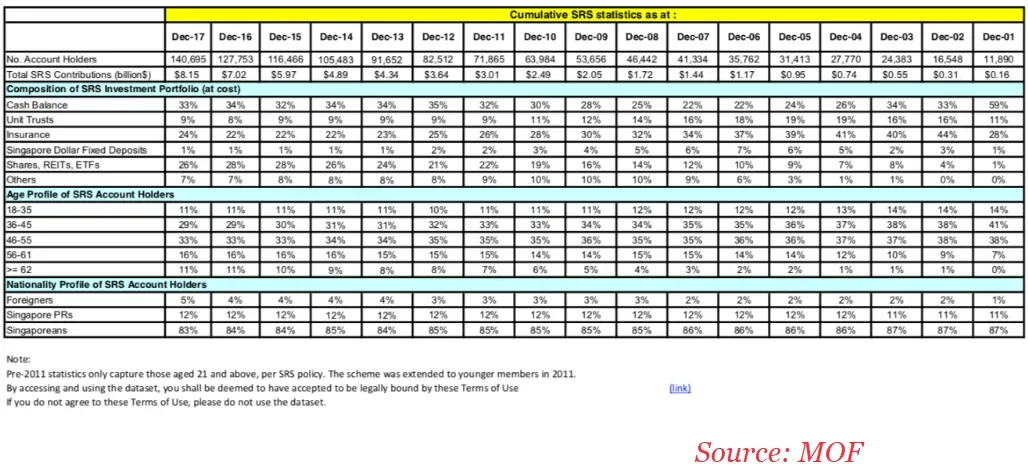
Interesting data: SRS deposits still amount to billions of dollars in cash!
As mentioned, maintaining your SRS funds in cash will yield a mere 0.05% return.
Interestingly, the graph below shows approximately one-third of total SRS funds are held as cash, which may seem unusual but it is indeed true.
This could possibly explain why banks are reluctant to raise the nominal interest rates for SRS accounts. If they were to increase the interest rates to 1%, it would result in significant additional costs for the banks.
Furthermore, it might further encourage individuals to keep their SRS funds in cash, which goes against banks' goal of providing wealth management solutions and ideas.
Note: Percentages may not add up to 100% due to rounding.
Note:
The statistics prior to 2021 only include individuals aged 21 and above, as per the SRS policy. However, in 2011, the scheme was expanded to include younger members. By accessing and utilizing the dataset, you will be considered to have agreed to the terms of use that bind you legally. If you disagree with these terms, kindly refrain from using the dataset.
Grow your money in your SRS account with
Here is a concise summary of the available investment choices that are generally considered beneficial for a long-term approach. Please note that if you have any uncertainties, it is advisable to seek advice from a qualified professional.
1. Singapore listed shares:
You have the option to invest your SRS funds in shares listed on the Singapore Exchange (SGX), including REITs. Please note that overseas listed shares are not approved for SRS.
2. Singapore listed retail bonds:
The SGX offers several retail bonds, which are corporate bonds issued by companies that provide regular coupon payments.
3. Singapore Savings Bonds (SSB):
You can purchase SSB up to a maximum cap of $200,000. However, personally, It is recommended to use cash for SSB purchases.
4. Retirement/Annuity plans:
Many insurance companies offer SRS-qualified plans, usually in the form of single premium plans.
5. Unit trusts and ETFs:
Both unit trusts and ETFs offer some degree of diversification. If you're just starting off investing, this may be a preferable approach. Additionally, most retail unit trusts are also eligible for SRS.
Remember, these options are better suited for a long-term investment strategy, and if you have any doubts or questions, it is advisable to consult with a professional.
If you're looking for a portfolio to put your SRS funds in
Here in srs.sg, we can help you build your SRS portfolio.
The portfolio will consist of six funds and will undergo reallocation and rebalancing every three months to ensure continuous optimization and positioning.
You can contact us here. Our email address: info@srs.sg
Conclusion
The SRS in Singapore can be an effective way to save for retirement while taking advantage of tax savings. Foreigners are increasingly opening SRS accounts, particularly younger people under 30 and you will probably gain from opening the account early because you will lock in the withdrawal age of 62.
See your own figures
The free calculators show what an SRS contribution does to your income tax, and what your retirement will cost.
A question about what you just read?
Ask here and a licensed adviser from our panel will reply within one business day. Introductions are free, and SRS.SG does not receive commissions or referral fees.