In this article (30 sections)

Key Highlights
Withdrawals from your Supplementary Retirement Scheme (SRS) account after the statutory retirement age receive a 50% tax concession.
Only half of your SRS withdrawals are subject to income tax if you wait until the prescribed retirement age.
You have a 10-year period to spread out your withdrawals, which can help lower your annual tax bill.
Early SRS withdrawals before your retirement age face a 5% penalty, and 100% of the withdrawn amount is taxable.
Strategic timing of your retirement savings withdrawals is essential to maximize your funds and enjoy tax relief.
Introduction
The Supplementary Retirement Scheme (SRS) is a valuable tool for boosting your retirement savings. While contributing to your SRS account offers immediate tax benefits, planning your withdrawals is just as important.
How and when you access these funds can significantly impact your financial well-being in your later years. Understanding the rules surrounding your SRS account ensures you make the most of your hard-earned money and minimize your tax obligations after you stop working.
Understanding Your SRS Withdrawal Options

When it comes to accessing your SRS funds, you have several withdrawal options. Your choices will directly affect your retirement planning and how your funds are taxed. You can withdraw your money in cash or, in some cases, as investments.
Understanding the differences between these methods is the first step toward creating an optimal withdrawal strategy. Your decision will depend on your financial needs, the investment products in your SRS account, and your long-term goals.
Let's explore the primary choices you face.
Lump Sum vs. Instalment Withdrawals
One of the most critical decisions in your retirement planning is whether to take your SRS funds as a single lump sum or in gradual instalments. Withdrawing everything at once provides you with a large amount of cash upfront. However, this can push you into a higher income tax bracket for that year, leading to a larger tax bill.
Conversely, instalment withdrawals allow you to spread out your withdrawal amount over a period of up to 10 years. This approach can help you manage your taxable income more effectively. By taking out smaller amounts annually, you might keep your chargeable income low, potentially reducing the overall tax you pay on your SRS savings.
For most people, gradual withdrawals are more tax-efficient. This strategy helps you make your retirement funds last longer and minimizes the tax impact, but the best choice depends on your personal financial situation and income needs.
Withdrawing Investments In-Kind vs. Cash
You don't always have to sell your SRS investments to access your funds. Besides a cash withdrawal, you have the option of an "in-kind" withdrawal. This means you can transfer your investment products, like stocks or unit trusts, from your SRS account to your personal brokerage account without liquidating them.
This can be a strategic move, especially if you believe your investments will continue to grow. An in-kind withdrawal allows you to hold onto your assets and avoid transaction costs associated with selling them. The value of the investments at the time of withdrawal is what gets reported for tax purposes.
Here are the key points:
Cash Withdrawal: You liquidate your investments and receive cash.
In-Kind Withdrawal: You transfer the actual investment products (e.g., shares) out of your SRS account. This flexibility in SRS withdrawals lets you manage your investment returns and fund retirement expenses in a way that suits your portfolio.
Tax Implications of SRS Withdrawals

Any withdrawal from your SRS account, whether in cash or as investments, is considered income. This means the withdrawal amount is added to your other sources of income for the year, like rent, and contributes to your total chargeable income. The final sum is then taxed at the prevailing income tax rates.
However, the government provides significant tax relief to encourage saving for retirement. The timing and circumstances of your SRS withdrawals determine how much of the amount is taxable. Understanding these rules is key to minimizing your tax burden.
1. Only Half Your Withdrawals Will Be Subject To Income Tax
Withdrawing from your SRS account can have significant tax implications. Notably, only half of your total withdrawals are subject to income tax, providing a valuable opportunity for tax savings. This feature allows SRS members to maximize their retirement funds while minimizing taxable income.
It's essential to understand how this affects your financial situation and plan your withdrawals accordingly. Consulting a financial adviser may help clarify your specific investment objectives and optimize your overall tax strategy during the withdrawal period.
2. You Have A 10-Year Withdrawal Period
Once you make your first penalty-free withdrawal from your SRS account at or after your statutory retirement age, a 10-year withdrawal period begins. This allows you to spread out your withdrawals over a decade, which is an effective way to stagger your withdrawals and manage your tax burden.
For example, if your first withdrawal is on April 1, 2024, your 10-year period will end on March 31, 2034. During this time, you can make multiple withdrawals. By controlling the withdrawal amount each year, you can keep your annual taxable income low and minimize the tax you pay on your SRS savings.
Any balance remaining in your SRS account at the end of this 10-year period will be deemed withdrawn. The SRS operator will report 50% of this remaining balance to the tax authorities, and this amount will be subject to tax in the following year. This rule encourages a structured drawdown of your retirement funds.
3. You Cannot Make More SRS Contributions Following Your First Withdrawal At or After Your Statutory Retirement Age
After making your first withdrawal from your SRS account at or after the statutory retirement age, no further contributions can be made. This restriction is crucial for managing your retirement savings effectively. Understanding this limit helps with comprehensive retirement planning, ensuring you adhere to your financial goals.
Additionally, recognizing that once you reach this stage, your SRS fund needs to support you without any new deposits becomes vital.
Proper financial advice can assist in navigating this transition smoothly within the framework of your overall financial situation.
4. Withdrawals Before Your Statutory Retirement Age Incur Penalties
Yes, there are significant penalties if you make an early withdrawal from your SRS account before reaching the statutory retirement age. The SRS scheme is intended for long-term retirement savings, and these penalties are in place to discourage premature withdrawals.
If you withdraw funds early, 100% of the withdrawal sum is subject to income tax. You will not get the 50% tax concession that applies to withdrawals made after retirement age. This means the full amount is added to your chargeable income, which could result in a much higher tax bill.
In addition to the tax, a 5% penalty is imposed on the total amount withdrawn. This penalty is non-refundable and is deducted by your SRS operator. There are a few exceptions for early withdrawals, such as on medical grounds or bankruptcy, but in most cases, withdrawing before your retirement age is a costly decision.
Timing Your SRS Withdrawals for Maximum Benefit
The timing of your SRS withdrawals is crucial for maximizing your tax savings and making your retirement funds last. The best age to start withdrawing is generally on or after the statutory retirement age that was in effect when you made your first SRS contribution.
By waiting until this age, you can access your money penalty-free and benefit from the 50% tax concession. Let's look at how the retirement age is determined for your account and the financial impact of withdrawing early versus waiting.
Statutory Retirement Age and Penalty-Free Withdrawals
You can make penalty-free withdrawals from your SRS account on or after the statutory retirement age that was in place at the time of your first SRS contribution. This is a key detail in your retirement planning. For example, if the retirement age was 62 when you opened your account and made your first deposit, you can start your penalty-free withdrawals at age 62.
This rule is locked in for you. Even if the government later raises the statutory retirement age to 63 or 65, your penalty-free withdrawal age remains 62. This provides certainty and allows you to plan your financial future with confidence.
Therefore, the best age to start withdrawing from your SRS account for maximum benefits is the statutory retirement age tied to your specific account. Waiting until this milestone ensures you avoid penalties and qualify for the valuable 50% tax concession on your SRS withdrawals.
Impact of Early Withdrawals and Associated Penalties
Withdrawing your SRS funds before reaching the statutory retirement age is generally not advisable due to the associated penalties. An early withdrawal has two major financial consequences that can significantly reduce your retirement nest egg.
First, your tax liability increases substantially. Unlike withdrawals made after retirement age, where only 50% of the sum is taxed, 100% of an early withdrawal amount is subject to income tax. This can push you into a higher tax bracket, especially if you still have employment income.
Second, an immediate 5% penalty is levied on the entire withdrawal amount. This penalty is deducted at the source by your SRS operator. The impact is clear:
Full Taxation: 100% of the withdrawal is taxable.
5% Penalty: A direct penalty is applied to the gross amount. These consequences are designed to preserve your retirement funds for your golden years, making early withdrawal a last-resort option.
Strategies to Optimize Your SRS Withdrawals
Simply waiting until retirement age is not the only strategy for your SRS withdrawals. With some careful planning, you can further optimize your payouts to maximize tax savings and extend the life of your retirement fund. Thinking strategically about when and how much you withdraw can make a substantial difference.
Seeking financial advice can be helpful, but there are several straightforward strategies you can consider. These methods focus on timing your withdrawals and structuring them to align with tax rules, ensuring you get the most out of your investment products and savings.
1. Make Our First Withdrawal On Any 1 January
A simple yet effective strategy to stagger your SRS withdrawals is to time your very first withdrawal carefully. The 10-year withdrawal period starts from the date of your first penalty-free withdrawal. To maximize this timeline, consider making your first withdrawal on January 1st of any given year.
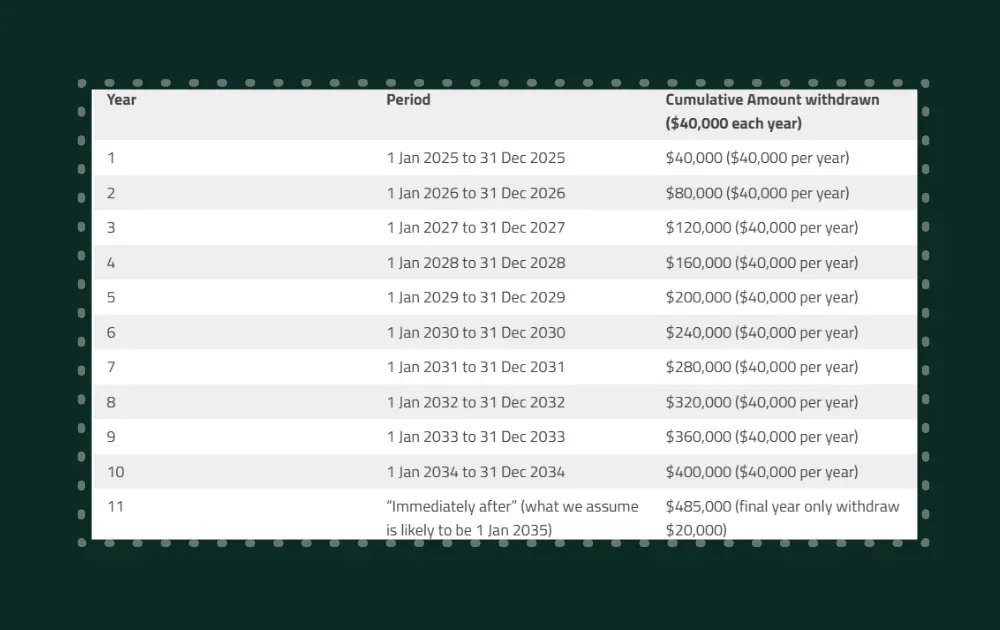
For example, if you start on January 1, 2025, your 10-year period will run until December 31, 2034. This gives you 10 full calendar years to spread out your withdrawals. If you were to start on a later date, say, December 30, 2025, your first "year" of the withdrawal period would only be two days long.
Starting on January 1st provides a clean, full-year structure for your withdrawal timing. This simple step helps you make the most of the decade-long window, giving you maximum flexibility to manage your retirement savings and annual tax obligations.
2. Only Withdraw From SRS When You Need It For Retirement Income
Your SRS account is designed to supplement your retirement income, so it makes sense to only withdraw funds when you actually need them to cover your expenses. There's no requirement to start withdrawing immediately upon reaching retirement age, especially if you have other sources of income.
Leaving your funds in the SRS account allows them to remain invested and potentially grow further, tax-free. Withdrawing money you don't need simply creates a taxable event without providing any real benefit. A financial adviser would likely suggest a needs-based approach.
Consider these points before making a withdrawal:
Do you have other income sources, such as rental income or CPF LIFE payouts?
What are your estimated annual expenses in retirement? By matching your withdrawal amount to your actual needs, you can keep your taxable income low and preserve your SRS capital for as long as possible.
3. Liquidating Investments To Purchase An Annuity Product
Another optimal strategy for your retirement savings is to use your SRS funds to purchase a life annuity. An annuity is an insurance product that provides you with a regular, guaranteed income stream for life. You can use a single premium from your SRS account to buy one.
When you purchase an annuity, the 10-year withdrawal period rule does not apply to the annuity payments. Instead, 50% of each annuity payment you receive will be subject to tax each year for the rest of your life. This can be an excellent way to secure a stable income and simplify your financial management in retirement.
This strategy involves:
Liquidating some or all of your SRS investments.
Using the cash to buy a single premium annuity product. This approach converts your SRS balance into a predictable income stream, which can be a cornerstone of your financial security.
4. Make A Final SRS Top-Up In The Year That We Want To Start Drawing Down
Here is a clever way to get one last bit of tax relief before you start your withdrawal period. In the same calendar year that you plan to make your first penalty-free withdrawal, you can also make a final SRS contribution.
As long as you make the SRS top-up before your first withdrawal, you are eligible for tax relief on that contribution. For example, if you plan to start withdrawing in December, you can make an SRS contribution in January of that same year to reduce your taxable income for that assessment year.
This allows you to benefit from one final round of tax savings on your SRS contribution. Remember, once you make that first withdrawal, you can no longer contribute to your SRS account. This strategy requires careful timing but can be a smart final move to boost your retirement savings.
5. Withdrawing $40,000 A Year For 10 Years
A popular strategy to maximize tax savings is to withdraw $40,000 in annual withdrawals from your SRS account for 10 years. If you do this after reaching retirement age and have no other source of income, you could potentially pay zero tax on your entire withdrawal.
This works because only 50% of the withdrawal amount, which is $20,000, is taxable. In Singapore, the first $20,000 of chargeable income is taxed at a rate of 0%. By spreading your withdrawals this way, you can draw down a total of $400,000 from your SRS account completely tax-free.
A financial adviser can help confirm if this is right for you, but the math is straightforward.
Year of Assessment | Withdrawal Amount | Withdrawal Amount Subject to Tax (50%) | Tax Payable |
|---|---|---|---|
YA 2025 | $40,000 | $20,000 | $0 |
YA 2026 | $40,000 | $20,000 | $0 |
...and so on for 10 years | ... | ... | ... |
6. Only Make SRS Withdrawals After Reaching The Statutory Retirement Age
The most fundamental strategy for your SRS withdrawals is to wait until you reach the statutory retirement age. This is the simplest and most effective way to protect your retirement fund. By being patient, you immediately unlock the two biggest advantages of the SRS scheme.
First, you achieve penalty-free withdrawal status. This means you avoid the 5% penalty that applies to early withdrawals, instantly saving a significant portion of your money. Second, you qualify for the 50% tax concession, which cuts your taxable withdrawal amount in half.
These benefits are designed to help you enjoy your golden years with more financial security. Rushing to access your funds before this milestone means leaving a lot of money on the table in the form of taxes and penalties. For the best benefits, waiting is almost always the right answer.
Managing Your SRS Account Post-Withdrawal Initiation
Your SRS journey doesn't end the moment you make your first withdrawal. Even after the withdrawal initiation, you need to continue managing your SRS account. The remaining balance in your account can stay invested, and it's important to keep an eye on its performance.
Properly monitoring your account ensures that your remaining SRS savings continue to work for you. You can still hold various investment products, and you'll need to keep track of your balance and withdrawal limits throughout your 10-year withdrawal period.
Continuing Investments After Beginning Withdrawals
Yes, you can absolutely continue investing the funds in your SRS account even after you start making withdrawals. The withdrawal initiation does not mean you have to liquidate all your assets. Your remaining SRS balance can stay invested in stocks, bonds, unit trusts, or other approved products.
This allows your money to potentially continue growing and generating investment gains, tax-free, within the SRS wrapper. You can even switch between different SRS investments based on your changing risk appetite or financial situation during retirement. This flexibility is a key feature of the SRS account.
While you cannot make new contributions, you retain full control over your existing SRS investments. This ensures your capital continues to work hard for you throughout your 10-year withdrawal period and beyond, helping to support your financial needs in retirement.
Monitoring Your SRS Account Balance and Limits
After you start withdrawals, active monitoring of your account becomes even more important. You need to keep track of your SRS account balance to understand how much you can withdraw and how it will affect your taxable income for the year.
Your SRS operator (the bank where you hold your account) provides statements and online access to help you with this. Regularly checking in helps you plan your annual withdrawal amount effectively. You should also be aware that the annual SRS contribution cap no longer applies to you, as you cannot make new contributions.
Key things to monitor include:
Your remaining account balance: This helps you plan future withdrawals.
The end date of your 10-year withdrawal period: Any funds left after this date will be deemed withdrawn and taxed. Staying informed helps you stay in control of your retirement funds.
Practical Aspects of Withdrawing from Your SRS

Now that you understand the strategies and rules, let's cover the practical side of the withdrawal process. Taking money out of your SRS account is a formal procedure that requires specific steps and documentation. You cannot simply transfer money out as you would with a regular savings account. The process is managed by your SRS operator, which is one of the three local banks (DBS, OCBC, or UOB).
To initiate a withdrawal, you will need to contact your bank and submit the required documents. The forms you need to fill out will depend on the reason for your withdrawal, such as reaching retirement age or withdrawing on medical grounds. Being prepared with the right paperwork will ensure the process goes smoothly.
Required Documents and Steps for SRS Withdrawals
To start the SRS withdrawal process, you must contact your SRS operator directly. They will provide you with the necessary forms and guide you through the steps. While the exact procedure can vary slightly between banks, the core requirements are generally the same.
You will typically need to complete a withdrawal application or declaration form. This form captures details about your withdrawal, including the amount and the reason. For special cases, like withdrawing on medical grounds, you will need additional supporting documents, such as a letter from a registered medical practitioner.
The key steps in the withdrawal process are:
Contact your SRS operator (your bank) to request a withdrawal.
Fill out the required SRS withdrawal or declaration form.
Submit the form along with any supporting documents, like proof of age or medical certification. Your SRS operator will then process the request and credit the funds or investments to your designated account.
Conclusion
Wthdrawing from your SRS account requires thoughtful consideration and strategic planning to maximize your benefits. Understanding your withdrawal options, the associated tax implications, and the timing of your withdrawals can greatly influence your retirement income. Remember to evaluate each decision based on your financial goals and retirement needs. After initiating your withdrawals, it's crucial to continuously monitor your account and make informed choices regarding your investments. If you have further questions or need personalized advice, don't hesitate to reach out for a consultation with our experts to ensure your retirement plan remains on track.
Frequently Asked Questions
Can I use SRS withdrawals to cover my retirement expenses in Singapore?
Yes, absolutely. The primary purpose of the Supplementary Retirement Scheme is to help you build up retirement savings to cover your expenses after you stop working. As a Singapore Citizen or Permanent Resident, you can use your SRS withdrawals to pay for your daily living costs, healthcare, and other financial needs during retirement.
Is it better to withdraw SRS funds all at once or gradually?
For most people, it is better to withdraw SRS funds gradually through instalment withdrawals. Taking a large lump sum can result in a much higher tax bill for that year. Spreading your withdrawal amount over 10 years helps keep your taxable income low, minimizing your overall tax burden.
What happens to my SRS funds if I become a non-resident or leave Singapore?
If you are a foreigner who has maintained your SRS account for at least 10 years and have been a non-resident for a continuous 10-year period, you can make a one-time full withdrawal. 50% of this withdrawal will be subject to withholding tax, but you will not face the 5% early withdrawal penalty.
See your own figures
The free calculators show what an SRS contribution does to your income tax, and what your retirement will cost.
A question about what you just read?
Ask here and a licensed adviser from our panel will reply within one business day. Introductions are free, and SRS.SG does not receive commissions or referral fees.