In this article (20 sections)
Key Highlights
Here are the key takeaways for building a secure future:
Securing a guaranteed income is essential for covering non-negotiable living expenses in retirement.
Your foundation for retirement income should separate essential needs from lifestyle wants.
CPF LIFE provides a government-backed, lifelong monthly income but may not cover all your needs.
If CPF LIFE is insufficient, a private income annuity can help bridge the gap.
Combining CPF LIFE with private annuities creates a layered strategy for long-term financial security.
Introduction
Effective retirement planning goes beyond simply saving money; it involves creating a reliable source of lifetime income that you can count on. While many avenues like stocks and property can generate cash flow, they often lack the predictability needed to cover life's essentials. For true peace of mind after you stop working, your core expenses must be funded by a steady income that is guaranteed for life.
This guide will show you how to build that secure financial foundation.
Understanding Guaranteed Monthly Income After Retirement

Achieving a guaranteed lifetime income is a cornerstone of a worry-free retirement. Unlike other investment options that fluctuate with the market, a guaranteed retirement income stream, often from an income annuity, provides predictable payments you can depend on.
This stability allows you to cover your essential expenses without fear of outliving your savings or facing a sudden income drop. Understanding how this differs from other income sources is the first step toward building a resilient financial plan. We will explore the key differences and why this approach is so critical.
Read more: How Much You Need In Your CPF Retirement Account (RA) At 65?
Defining “Guaranteed” vs. Regular Investment Income
The primary difference between a guaranteed income and regular income from investments lies in predictability and risk. Regular income often comes from investment options like stocks, certificates of deposit, or rental properties. These sources are subject to market risk—dividends can be reduced, and tenants may leave, causing your income to fluctuate unexpectedly.
In contrast, a guaranteed income, such as that from an annuity or a social security program like CPF LIFE, is a contractual promise. An insurer or government body commits to paying you a fixed amount for a specified period, often for life. This shields you from market downturns and ensures your core financial needs are always met.
You trade the potential for higher, but uncertain, returns for the certainty of a stable cash flow through investment portfolios. This security is what makes guaranteed products a fundamental part of retirement planning for many.
Why Guaranteed Income Matters for Singaporean Retirees
For Singaporean retirees, securing a lifetime income is crucial for achieving genuine financial security. Relying solely on market-based investments to cover essential expenses exposes your retirement savings to unnecessary risks.
During periods of market volatility, you might be forced to sell assets at a loss just to pay your bills. A guaranteed income stream removes this pressure, providing a stable foundation that is unaffected by economic cycles. This stability allows you to manage your other investments with a long-term perspective, rather than for immediate cash flow needs.
Key benefits include:
Protection against market downturns.
Certainty that essential bills will always be paid.
Reduced stress and anxiety about outliving your savings.
The freedom to use other assets for discretionary spending.
Assessing Your Retirement Needs and Goals
Before you can build a reliable income stream, you must define your retirement goals. This involves calculating exactly how much you will need each month to live comfortably. Identifying your essential expenses is the most important part of this process.
Your goal is not just to protect your nest egg but to make it work for your specific financial objectives. A clear understanding of your needs versus your wants will guide every decision you make, from optimizing your CPF to considering other income sources. The following sections will help you determine your unique financial requirements.
Read more: Retirement in Singapore’s High-Cost Economy: Key Insights
How Much Monthly Income Do You Really Need?
Determining your required monthly income is the first practical step in retirement planning. It is not enough to guess; you need to separate your non-negotiable expenses ("needs") from your discretionary spending ("wants"). Needs include housing, food, utilities, and healthcare, while wants cover travel, hobbies, and entertainment.
Your various income sources must first be allocated to cover your needs. This ensures that no matter what happens in the market, your basic lifestyle is secure. Your calculation should also account for factors like inflation and a long life expectancy.
A simple way to visualize this is by creating a budget. This helps clarify the exact amount of guaranteed income you need to secure.
Expense Category | Monthly Cost (Needs) | Monthly Cost (Wants) |
|---|---|---|
Housing & Utilities | $1,200 | $0 |
Food & Groceries | $800 | $400 (Dining Out) |
Transport | $300 | $200 (Taxis) |
Healthcare & Insurance | $500 | $0 |
Hobbies & Travel | $0 | $800 |
Total | $2,800 | $1,400 |
Factors that Influence Lifetime Income Requirements
Your required lifetime income is not a static number; it is influenced by several personal and economic factors. Beyond your basic essential expenses, you must consider how your needs might change over time. Rising health care costs, for example, are a significant concern for most retirees.
Your existing sources of income and assets, such as savings or life insurance policies with cash value, will also shape your requirements. A comprehensive plan accounts for these variables to prevent future shortfalls.
Key factors that can impact your income needs include:
Inflation, which erodes the purchasing power of your money.
Unexpected medical or long-term care expenses.
Your desired lifestyle and travel ambitions.
Financial support you may provide to family members.
Read more: 4 Singapore-Specific Challenges for FIRE Aspirants
CPF LIFE—The Foundation of Retirement Income in Singapore

For Singaporeans, CPF LIFE serves as the bedrock of retirement income. It is a national longevity insurance annuity scheme that provides a guaranteed social security benefit for as long as you live. This means you receive a monthly income payment without worrying about market fluctuations or outliving your savings.
Because it is government-backed, CPF LIFE offers a high level of security, making it the ideal starting point for anyone planning their retirement. The next sections will explain how this system provides lifelong payments and how you can maximize its benefits.
How CPF LIFE Provides Lifelong Payments
CPF LIFE operates as a life annuity, which is designed to provide a lifetime income. When you join the scheme, a portion of your CPF savings is used to pay an insurance premium. This premium is pooled with those of other members, and the accumulated sum is invested by the government.
From this professionally managed fund, you receive a guaranteed income each month for the rest of your life along with a death benefit. This structure effectively functions like a national social security program, spreading longevity risk across the entire population. This ensures that even if you live longer than average, your payments will not run out.
This mechanism is what allows CPF LIFE to deliver on its promise of lifelong payouts, offering a level of security that is difficult to replicate with private investments alone.
Read more: 2026 CPF Changes Explained: How Much Will You Really Receive?
Maximizing Your CPF Contributions for Greater Returns
The size of your CPF LIFE payout is directly tied to the amount of retirement savings in your Retirement Account (RA) at age 55. Therefore, maximizing your CPF contributions, much like investing in dividend stocks, is a straightforward way to secure higher returns in the form of larger monthly payments.
A simple step is to top up your RA, either with cash or by transferring funds from your Ordinary Account (OA). While you can do this on your own, consulting a financial professional can help you align this strategy with your broader retirement goals.
To boost your future CPF LIFE payouts, consider these actions:
Top up your RA to the current Full Retirement Sum (FRS).
Aim for the Enhanced Retirement Sum (ERS) for the highest possible payouts.
Make these top-ups early to take advantage of compounding interest.
Read more: Are You Financially Stable, Independent, or Free?
CPF LIFE — Your Retirement Income Baseline
Think of CPF LIFE as the baseline for your retirement income. It is the most secure and reliable of all your potential income sources, designed to provide a steady income for life. However, for many people, the payouts may only cover basic living expenses, not the lifestyle they desire.
The key is to use CPF LIFE as your foundation and then build upon it. The following steps will guide you through a process of assessing your needs, checking for shortfalls, and layering additional income streams to create a comprehensive plan.
Step 1: Separate Needs from Wants
The first simple way to structure your retirement plan is to distinguish clearly between your needs and wants. Your needs are the essential expenses you cannot live without, such as housing, food, and utilities. Your wants are the lifestyle enhancers, like travel and dining out.
Your primary financial objective should be to cover all your needs with guaranteed income sources. This is because needs should not depend on fluctuating markets. If your essential income is secure, you can fund your wants with more flexible, and potentially higher-risk, investments without jeopardizing your basic security.
This separation provides clarity and discipline.
Needs: Food, transport, housing, insurance premiums.
Wants: Hobbies, frequent travel, luxury goods.
Cover needs with guaranteed income first. Fund wants with other investments.
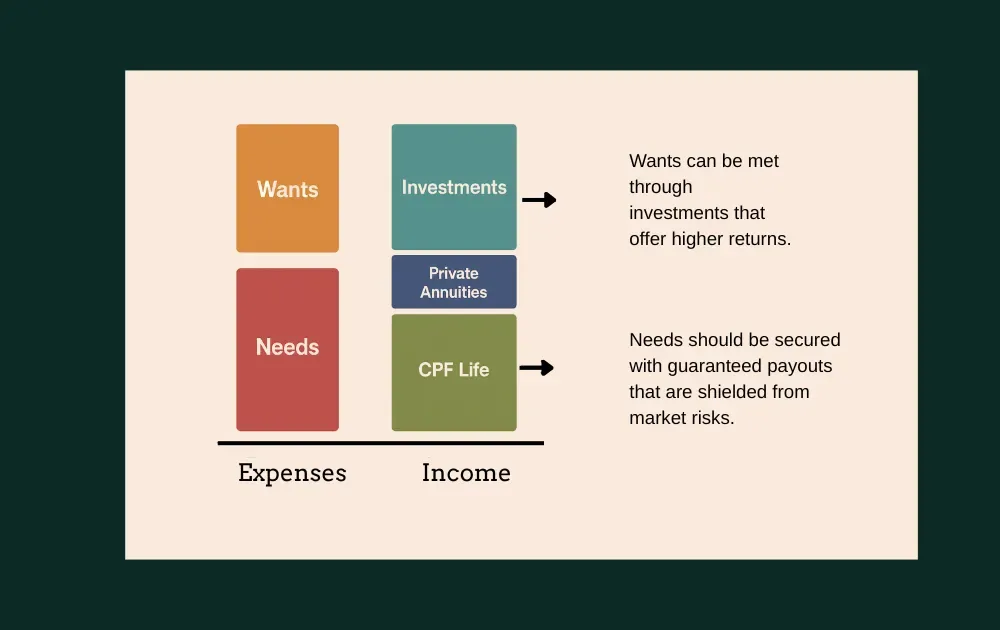
Diversification is key when it comes to managing your income sources. Markets are volatile, dividends can fluctuate, and unexpected events can impact your financial stability. Relying solely on traditional income streams such as stocks, bonds, or rental properties for your essential expenses can leave you vulnerable during economic downturns.
Annuities offer a stable source of income that is insulated from market fluctuations, providing a safety net for covering your basic needs. By securing your essential expenses with annuities, you can navigate through market uncertainties without the fear of having to compromise your lifestyle or make hasty decisions like selling assets at unfavorable times.
With annuities taking care of your necessities, you can allocate your investment portfolio towards fulfilling your discretionary wants and goals. This separation ensures that you have the flexibility to ride out market cycles without the pressure of liquidating investments during turbulent times.
By strategically incorporating annuities into your financial plan, you create a resilient foundation that allows you to weather financial storms with confidence and maintain financial stability over the long term.
Step 2: Check If CPF LIFE Is Enough
Once you know your monthly needs, the next step is to compare this figure with your projected CPF LIFE payout. You can get an estimate of your future income payment from the CPF Board website. This will reveal if there is a gap between what CPF provides and what you need.
If you find a shortfall, your first and most effective option is often to boost your retirement savings within CPF to increase your payouts. Consulting a financial advisor can help you understand the long-term implications of topping up your account versus seeking other solutions.
Here is an example of what this calculation looks like:
Financial Element | Monthly Amount |
|---|---|
Required Monthly Income for Needs | $5,000 |
Projected CPF LIFE Payout (at ERS) | $3,300 |
Retirement Income Shortfall | ($1,700) |
Read more: Make the Most of Your 20s: Plan Retirement Early
Step 3: If You’ve Optimized CPF LIFE, Use Private Annuities
What if you have already maximized your CPF LIFE contributions and still face an income gap? This is where private annuities become a valuable part of your retirement plans. A private lifetime income annuity works similarly to CPF LIFE: you pay a lump sum to an insurance company, which then provides a guaranteed monthly payout.
While their returns may not be as high as CPF LIFE's, private annuities offer greater flexibility. You can customize them to fill the exact shortfall identified in your plan, ensuring your needs are fully covered without relying on volatile market investments.
Key advantages of private annuities include:
You can choose when your payouts begin.
Payments can be structured for a fixed term or for life.
You can select a payout amount to match your specific needs from different types of annuities.
They provide certainty that your essentials are covered.
Conclusion
Building a guaranteed monthly income for life after work is essential for ensuring financial stability during retirement. By understanding the intricacies of guaranteed income sources like CPF LIFE, and adequately assessing your retirement needs, you can make informed decisions that safeguard your financial future. It’s crucial to separate your needs from wants and explore private annuities if necessary to supplement your income.
As you plan for a secure retirement, remember that taking proactive steps today can lead to a comfortable and stress-free tomorrow. If you need assistance or further insights into optimizing your retirement income strategy, don't hesitate to reach out for a consultation.
Frequently Asked Questions
Can guaranteed monthly income protect against inflation in Singapore?
A guaranteed income provides stability against market risk, but standard fixed payouts do not automatically adjust for inflation. This means the purchasing power of your retirement income may decrease over time, a factor to consider in your overall financial strategy.
Are annuities suitable for early retirees or only traditional retirement ages?
While CPF LIFE has a set payout age, private annuity products are highly flexible. An income annuity can be structured to start providing lifetime income at nearly any age, and withdrawals of taxable amounts can also be managed effectively, making it a suitable tool for early retirement plans.
What are the risks or downsides to relying solely on guaranteed income products?
Relying only on guaranteed income has downsides. Funds are often illiquid, and fixed payments may not keep pace with inflation, creating a form of longevity risk. You also miss out on potential market growth that could otherwise increase your wealth.
See your own figures
The free calculators show what an SRS contribution does to your income tax, and what your retirement will cost.
A question about what you just read?
Ask here and a licensed adviser from our panel will reply within one business day. Introductions are free, and SRS.SG does not receive commissions or referral fees.